Gold and silver prices are steadying right now after spiking and crashing in the most volatile action since 2008 and 1987 respectively. But volatility could return as China’s wholesale bullion markets shut on Friday for the week-long Chinese lunar New Year holidays.
China is the No.1 gold-mining nation, the No.1 importer and consumer, and most likely the No.1 central-bank gold buyer, too. This dominance in gold’s physical flows has been true for well over a decade, but it’s the explosion of speculation and derivatives betting which has really seen China’s trading activity start to set the direction of bullion prices worldwide.
Besides its timeless appeal as a ‘safe haven’ asset, gold has also offered a way to play Asia’s economic growth in the 21st century. China and India combined account for one ounce in every two of the world’s end-user gold demand each year, and the dramatic boom in disposable incomes since the turn of the millennium has enabled Asian consumers to pay ever-higher prices for the precious metal.
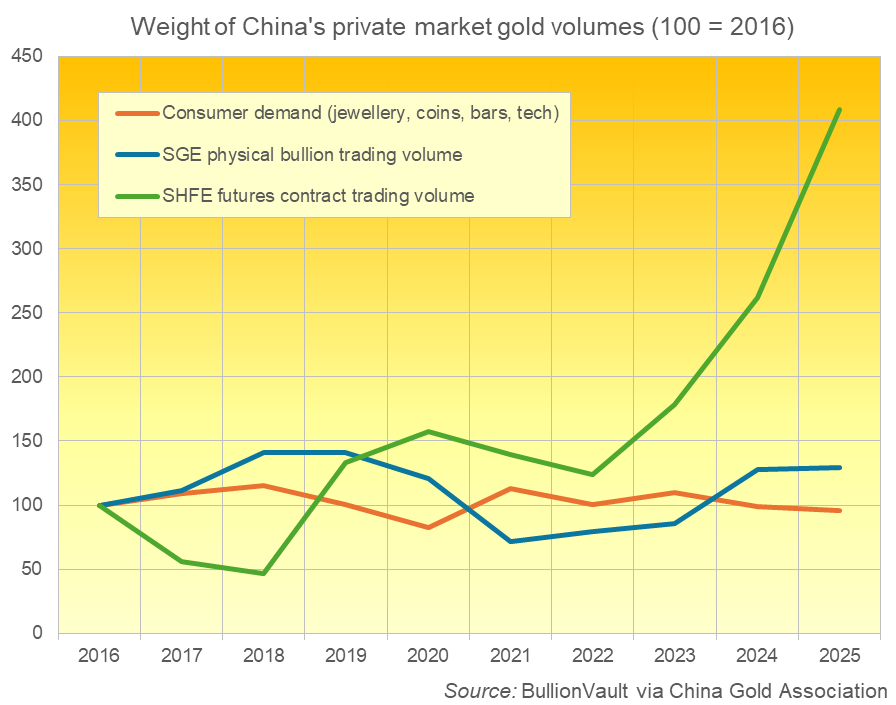
Despite the price of gold quadrupling in Yuan terms over the past decade, China’s household gold demand has remained very consistent. So too has the level of physical bullion trading done through the Shanghai Gold Exchange.
In contrast, derivatives trading through the Shanghai Futures Exchange have exploded in the past three years. Coinciding with the start of gold’s current bull market, this move began as Western gold investment actually fell following the pandemic, with physical investors in Europe and North America taking profit through platforms such as BullionVault while ETFs such as the GLD saw heavy outflows.
Previously, analysts and traders in gold would have expected Western investment outflows to push prices lower. Instead, the precious metal rose to new record highs in 2023 and 2024 as Chinese trading and investing jumped. That trend then continued in 2025 as Western investing rebounded with the return of Donald Trump to the White House, spiking over Christmas and New Year 2026 on what US Treasury Secretary Scott Bessent rightly calls ‘unruly’ trading in China.
While the speculative blow-off to $5600 gold and $120 silver came amid a frenzy in unregulated derivatives trading in China, the country’s underlying bid for gold and silver shows no sign of letting up. Chinese New Year is now the largest single gold-buying festival worldwide, overtaking Diwali in India. And with prices surging almost three-fold for Chinese consumers over the past five years, households wanting to get the most gold for their money are increasingly switching from high-margin jewellery to buying small bars and coins instead, as well as investing in physical bullion accounts and trading gold ETFs, too.
China’s move away from adornment and towards investment in gold reflects and will also enable the underlying bull market in bullion to continue.