Have passive investors in fixed income been leaving money on the table? In this analysis, Marc Seidner, CIO Non-traditional Strategies and Mohit Mittal, CIO Core Strategies at PIMCO, use some hard data to highlight how re–evaluating passive bond allocations – which have historically underperformed active strategies – may open the door to improved investment outcomes.
Don’t leave money on the table. It’s a central tenet of investing to seek the most from every opportunity and not settle for less than you could potentially earn.
Investors in passive fixed income allocations have been leaving money on the table.
Passive investing has grown in popularity ever since the first S&P 500 index-tracking fund launched in the 1970s. Many investors have been drawn into passive fixed income allocations, such as index-tracking funds, amid a common refrain that passive is better because it costs less. But in fixed income, the numbers tell a different story: The myth that active managers can’t beat the market after fees is demonstrably false in bonds. Passive fixed income investors pay less and may get less.
Back in 2017, PIMCO published “Bonds Are Different: Active Versus Passive Management in 12 Points.” The publication showed that a majority of active bond funds and exchange-traded funds (ETFs) beat their median passive peers after fees over a variety of time periods. Given everything that’s happened since 2017, we thought we would revisit that thesis to quantify how it has held up.
Let’s look at some hard data, focusing on the true apples-to-apples comparison: net-of fee returns. Our analysis, spanning two decades, shows that Active Bond Funds in general have outperformed their passive counterparts in 64% of the rolling 10-year periods examined (see Figure 1). This is well above the 43% rate of Active Equity Funds beating their passive peers:
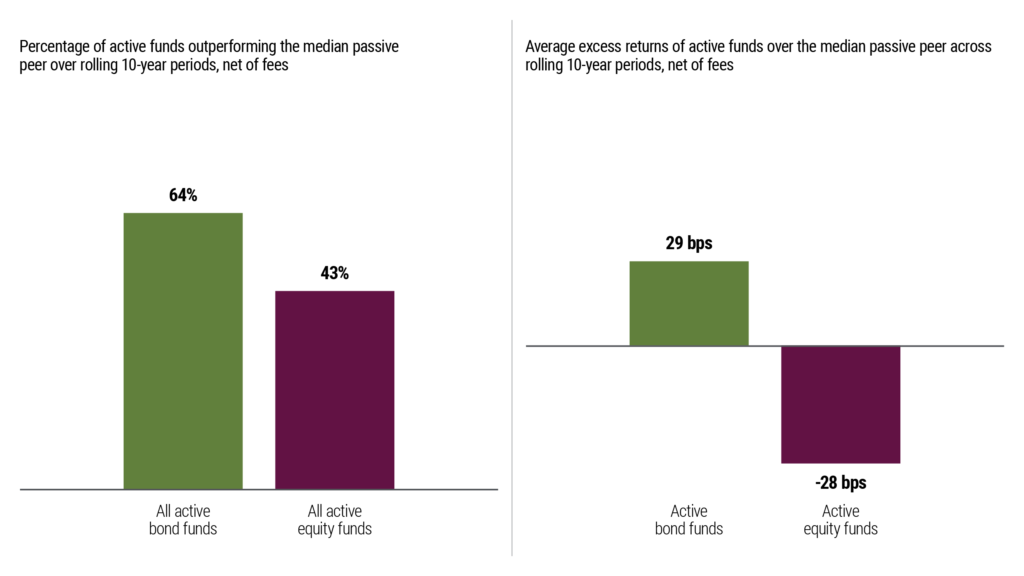
Again, that analysis spans two decades – from a financial crisis to a pandemic, from the 10-year Treasury yield reaching its all-time low to an inflation spike to a generational reset higher in bond yields, from bear to bull markets and everything in between. Across that vast variety of conditions, active management in fixed income outperformed passive on average.
Yes, active management costs more – typically about 35 basis points (bps) more across the five largest Morningstar fixed income categories by assets under management, as of 30 September 2025. But when active management is generating more than that in terms of alpha, or outperformance versus the broad market, the math is simple. Net-of-fees, active fixed income can deliver improved returns.
Market inefficiencies create active opportunities
Passive fixed income investing has a poor track record in part due to bond market quirks that favor active management. For example, almost half of the global bond market consists of investors such as central banks, insurance companies, and commercial banks that operate with unique objectives and constraints.
Many of these investors seek beta, or broad-based market exposure, rather than alpha. Their primary mandates – think currency management, regulatory capital, or book yield – can create persistent market inefficiencies. For example, when passive funds are locked into following periodic index rebalancing rules, market prices move, allowing active managers to anticipate, act, and seek to profit.
The complexity of bond markets makes index replication challenging. Unlike equities, bonds mature, creating constant turnover. Bond indexes also assign the highest weights to issuers with the most debt outstanding, not necessarily those with the best economic value. Passive managers often hold less than half the index, leading to tracking error.
New bond issues are often priced at a discount to attract buyers, and active managers can look for these opportunities. Structural alpha, sought by identifying repeatable market inefficiencies, is a key tool for active management outperformance.
Active investing for improved outcomes
To conclude here, investors have a variety of goals. Pension funds need liability matching and real returns. Endowments and sovereign wealth funds seek diversification. Individual investors often look for income and diversification from stock-market volatility.
Passive fixed income strategies typically take a one-size-fits-all approach and have a history of underperformance versus their active peers on average. Active management has historically delivered improved after-fee returns, greater flexibility, and customized solutions versus passive peers on average. With today’s robust market liquidity in public fixed income, active managers can shift across sectors, geographies, and maturities – something passive funds simply can’t do.
With starting yields near multi-year highs and geopolitical volatility creating fresh opportunities, now is the time to consider making the switch. Don’t leave money on the table – make your fixed income allocation work harder for you.
This feature was part of our 2026 Fixed Income Insights. For deeper analysis on bond markets and rates strategy for advisers, explore IFA Magazine’s latest Fixed Income Insights publication.
About Marc Seidner
Mr. Seidner is CIO Non-traditional Strategies and a managing director in the Newport Beach office of PIMCO. He is also a generalist portfolio manager and a member of the Investment Committee. He rejoined PIMCO in November 2014 after serving as head of fixed income at GMO LLC, and previously he was a PIMCO managing director, generalist portfolio manager and member of the Investment Committee until January 2014.
About Mohit Mittal
Mohit Mittal is CIO of Core Strategies and a managing director based in the Newport Beach office of PIMCO. He is a member of PIMCO’s Investment Committee and a portfolio manager on multi-sector fixed income portfolios across the duration and credit spectrum. As CIO of Core Strategies, he oversees strategies including our Total Return and Investment Grade Credit suite of solutions. Morningstar named him the 2020 U.S. Award winner for Investing Excellence (Rising Talent).