

UK shares are among the cheapest in the world, according to new analysis from Fidelity International.
Comparing major stock markets across a range of metrics, Fidelity finds the UK consistently ranks as one of the least expensive developed markets. In contrast, the US stands out as the most expensive, following strong gains in large technology companies.
Valuation snapshot
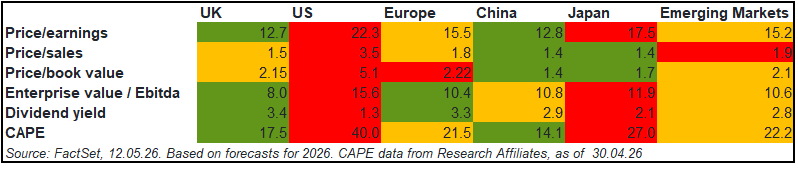
This table provides a snapshot of how stock markets are valued around the world. It brings together six commonly used measures that compare share prices with fundamentals such as company earnings and dividends. A lower number generally means a cheaper investment, except when it comes to the dividend yield, while higher numbers suggest a more expensive one.
The picture is clear: the UK stands out as one of the cheapest markets across most measures. By contrast, the US is the most expensive by a wide margin.
One of the most closely watched indicators, the cyclically adjusted price-to-earnings (CAPE) ratio, highlights this gap. The CAPE ratio is a more sophisticated version of the price/earnings ratio. It looks at a stock market’s profits from the past 10 years, takes an average, and adjusts it for inflation.
Investors turn to home market
Recent research* by Fidelity suggests investors could already be responding to these differences. Almost half (47%) of UK retail investors say they expect to increase exposure to their home market over the next 12 months, compared with 31% for emerging markets and 29% for the US.
This points to a growing focus on value, even as investors continue to back global growth opportunities.
A widening gap
A decade ago, UK and US markets were valued at similar levels. Since then, the gap has widened significantly, as US stocks – particularly in technology – have surged ahead.
US stocks are far more expensive than UK ones – but they haven’t always been
Forward price/earnings ratio
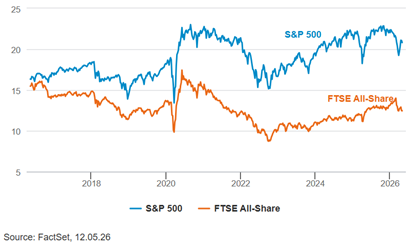
More recently, the FTSE 100 has shown signs of catching up, supported by sectors such as energy, mining and defence. However, US valuations are climbing again following a bumper earnings season.
Balancing value and growth
While cheaper markets may offer opportunities, higher valuations often reflect stronger expectations for future growth. Markets such as the US and, more recently, Japan have attracted strong investor demand, pushing valuations higher.
This leaves investors balancing two key questions: where markets look cheapest today, and where future growth is likely to come from.
Jemma Slingo, Pensions and Investment Specialist at Fidelity International comments: “Valuation gaps between markets are now quite stark. The US continues to look expensive, largely because of the strength of its technology sector, while the UK stands out as much cheaper.
“These differences reflect contrasting expectations for growth. Ultimately, when assessing any valuation metric, investors are making a call about growth. If a company, region or sector is expected to grow quickly, it will tend to command a higher valuation. It is when doubts creep in that problems can arise. Our research suggests investors could be looking more closely at these cheaper areas of the market.
“For investors, this highlights the trade-off between price and growth potential. Cheaper markets may offer opportunities, but much depends on whether expectations improve from here.”