
Artificial Intelligence has captivated investors and policymakers alike, but is the excitement justified or are we in the early stages of an AI bubble? Richard Flax, Chief Investment Officer at Moneyfarm, examines the data, the hype and the fundamentals to ask whether today’s optimism around AI echoes past market manias or reflects a genuine technological revolution.
The question of whether or not AI is a “bubble” has been a key question for investors over the past few months. We don’t think we’re there, but there are some warning signs that we’ll continue to monitor.
What is a bubble? The standard answer is that it’s a period where asset prices (for stocks, houses etc) rises far above some idea of intrinsic value. That’s fine as far as it goes, but it’s not always practically useful. After all, what is intrinsic value – particularly for assets like stocks that typically embed some expectations about the future?
If we look back at past periods which have been described as bubbles we may see some common characteristics. A new technology emerges that has the potential for significant change. Investors and businesses get very excited. They try to predict who are the likely winners – both companies and sectors – and allocate capital to those sectors. Hopes for the impact of the new technology continue to rise and more capital floods into the sector. Valuations and expectations continue to rise. Eventually, some sense of disappointment / reality kicks in – often because too much money is chasing too little opportunity. Expectations deflate, asset prices fall, some businesses and investments disappear and the “bubble” has deflated.
Periods that are typically considered bubbles include – 19th Century railroads in the US, the telecom / fibre boom of the 1990s and the internet boom in the late 1990s – 2000. Looking at that list, it’s worth highlighting that a “bubble” doesn’t mean that the technology failed or proved irrelevant, more that expectations about the scale and, importantly, the timing of adoption proved too optimistic.
Where are we now? There’s certainly a lot of hype around Artificial Intelligence – it dominates investment debate and news articles. Investors and policy makers hope that AI will help raise productivity and drive prosperity and economic growth. The amount of capital being allocated sounds enormous – raising questions about how those investments will be paid for. One estimate sees capital spending on AI data centres reaching $3 trillion between 2025 and 2029. Spending on new datacentres to support Artificial Intelligence even shows up in the macroeconomic data – clearly supporting US economic growth. ChatGPT, an AI chatbot, currently has 800 million weekly users, according to its CEO, and that figure has been doubling every eight months. AI strategies are being defined and implemented in boardrooms around the world. Shares in companies that benefit from the AI boom – notably chip designer Nvidia – have rallied sharply over the past few years.
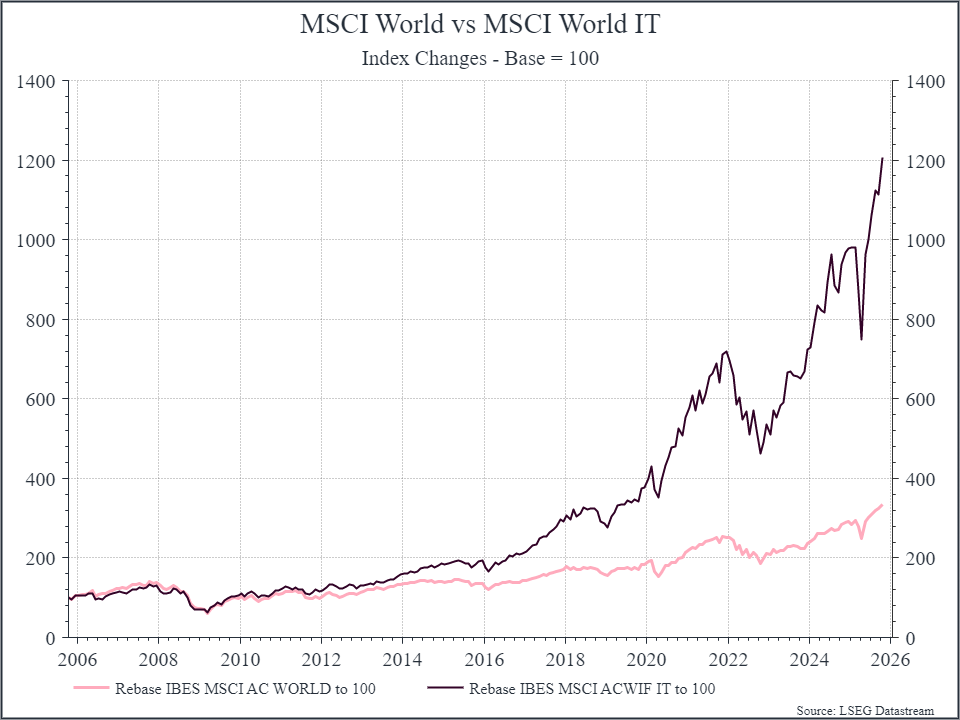
All those expectations are being reflected in equity markets. The chart below shows the sharp outperformance of global tech (the dark line) compared with global equities over the past decade.
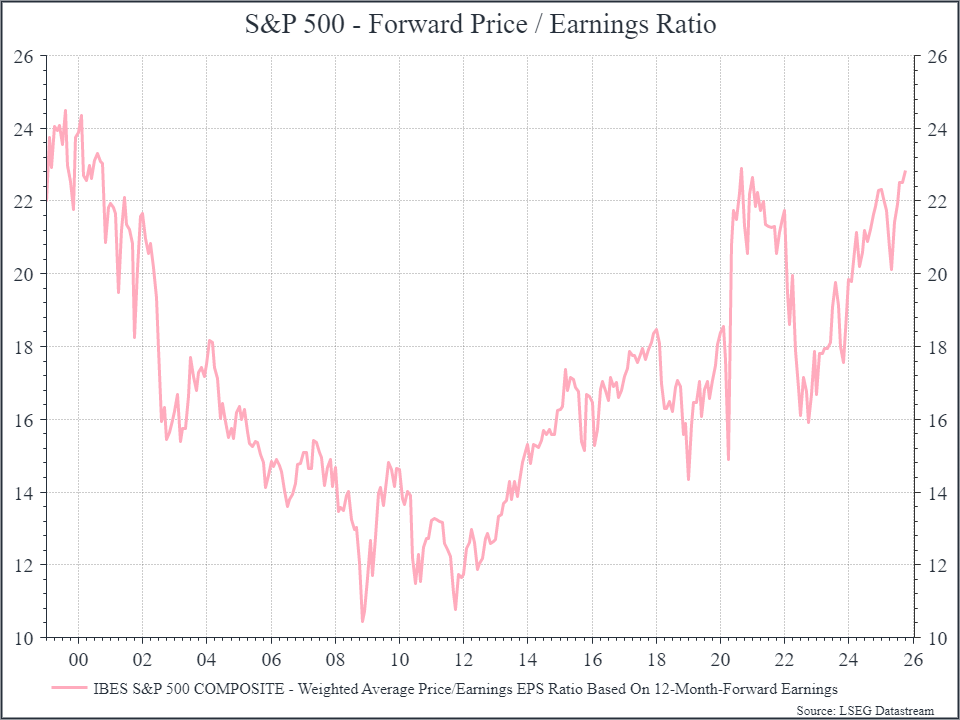
The chart below shows the forward Price/Earnings ratio for the S&P 500 over the past thirty years. On this metric, the US equity market is approaching valuations seen in 2021 and back in 1999 / 2000. At the very least, we can say that equity investors are optimistic about the future.
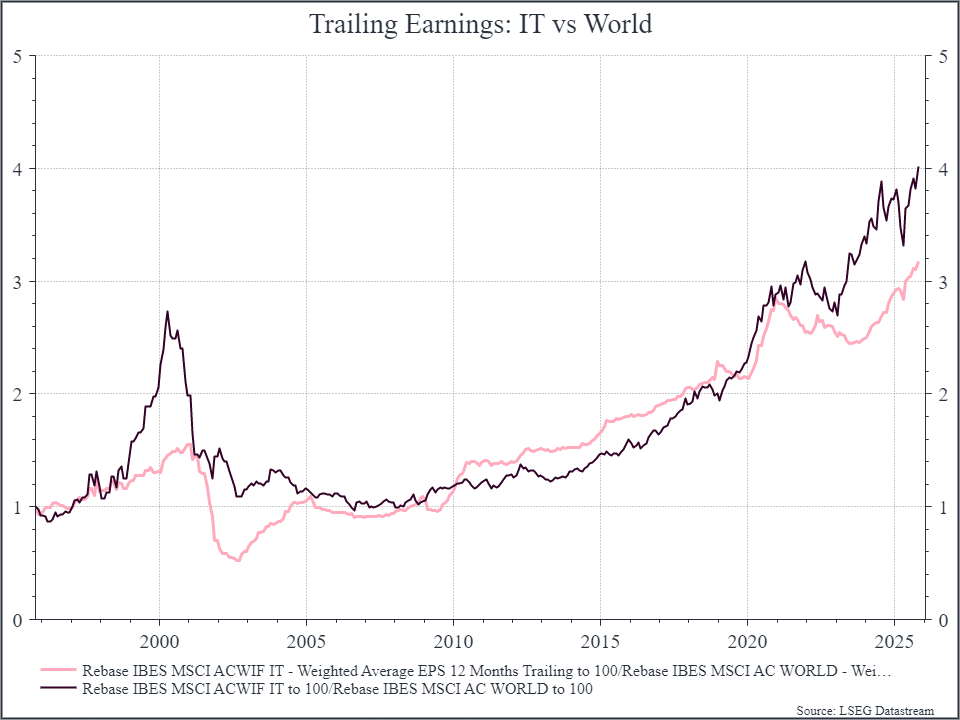
But does that qualify as a bubble? Let’s look at the chart below. It compares the global tech sector and global equities. Global tech is more than just AI, but the large listed US technology companies are well represented. The dark line shows the relative valuation of global tech (dominated by US tech companies) and global equities. The light line compares the trailing earnings for global tech and global equities. We can see that over time, the relative valuation of global tech has risen as the tech earnings have grown faster than the rest of the world. That wasn’t the case during the internet boom in 1999 and 2000. As the chart shows, investor optimism in global tech wasn’t reflected in rising earnings – it was largely built on the hopes and dreams that only came to fruition in the following two decades. We should note that on this chart at least, the two lines have begun to diverge – maybe reflecting greater optimism about future earnings for Global tech.
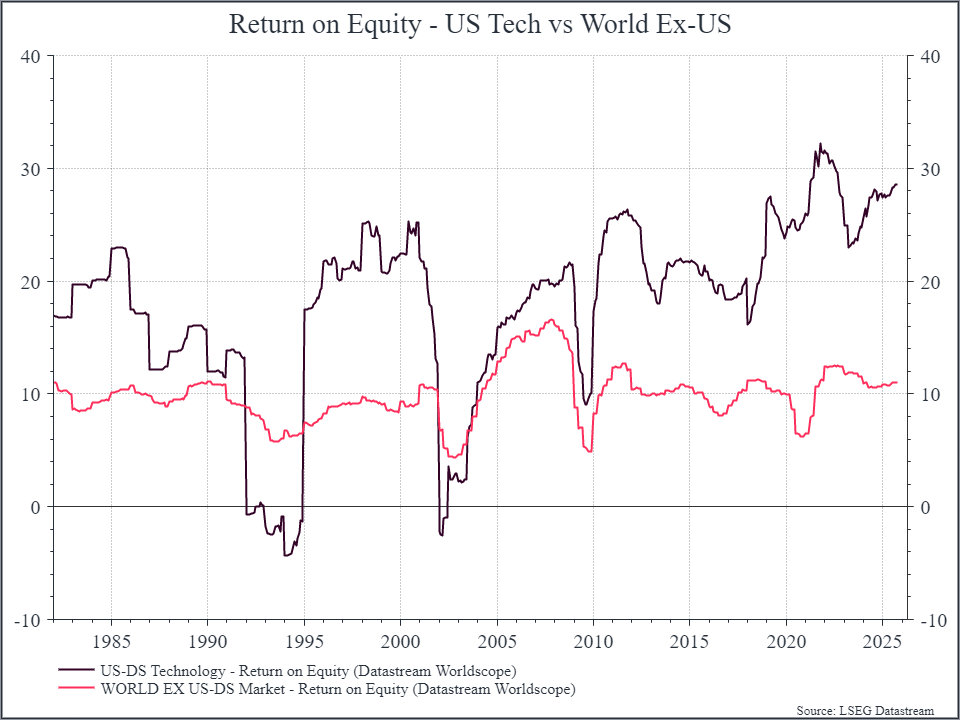
Looking at return on equity (ROE) – a broad measure of corporate returns – we can see that US tech has performed well. The chart below shows the ROE for the US technology sector and the World excluding the US. The gap between the two has grown steadily in the past fifteen years, even if we did see a similar difference during the internet boom. The rising ROE in US tech highlights again that investors haven’t just been buying future hopes and dreams – technology earnings have grown quickly and the returns that these businesses generate are high and rising. But one key question is whether that will still be the case in the wake of all the investment that we’re currently seeing.
So we can say that the fundamentals look pretty robust, even if valuations are above their long-term averages. That might mean muted long-term returns, but it doesn’t necessarily shout “bubble”. But looking forward, the question is whether all the capital investment that large tech companies are making will earn a decent return. As mentioned before, the absolute numbers are very large. The good news is that many of the businesses making those investments typically generate a lot of cash, and they’ll be able to fund some part of that investment themselves. And we expect that there’ll be partners available to help fund the remainder.
But just because you have the cash to invest doesn’t mean it’ll be positive for the business. We think the real question is on the demand side. Weaker-than-expected demand will leave these businesses with assets (data centres) that aren’t generating much of a profit. We would see that reflected in disappointing earnings growth and a lower return on equity. It would be consistent with what we’ve seen in the past. Too much capital chasing too few opportunities. So far, we think that demand remains pretty robust – second quarter earnings growth was robust for US tech and the latest signs from the tech supply chain (notably TSMC, the semiconductor giant) suggest that demand has remained strong in the third quarter. We’ll get a better sense of that in the coming weeks. There are some warning signs – notably some complicated deals that are effectively vendor financing – where tech companies effectively provide the resources for customers to purchase their products.
Where does this get us? The current environment has similarities with past bubbles – notably, a potentially transformative technology, huge amounts of investment and high expectations. But it’s worth noting that underlying demand looks robust, profitability remains high and most of the listed businesses investing in the new technology are highly cash generative. Based on their current plans, they’ll need to be!
For now, we think that the case for an AI bubble hasn’t been proven. But expectations are undoubtedly high. We’ll need to keep a close eye on demand for signs that AI adoption continues to grow and the so-called tech hyperscalers continue to see that adoption show up in their earnings.