
Multi-asset investing has become a key part of advisers’ centralised propositions over the years. But is it still delivering, and are advisers leaning in or stepping back? The latest IFA Magazine readers’ survey, carried out recently in conjunction with Schroders, suggests something reassuring: multi-asset isn’t just holding its ground, it’s quietly strengthening its position.
With 119 completed responses to our survey gathered over a two-week period, the results paint a clear and confident picture. Multi-asset strategies remain embedded in advisers’ client solutions, and for many firms, their role looks set to expand rather than contract.
Confidence is high and stable
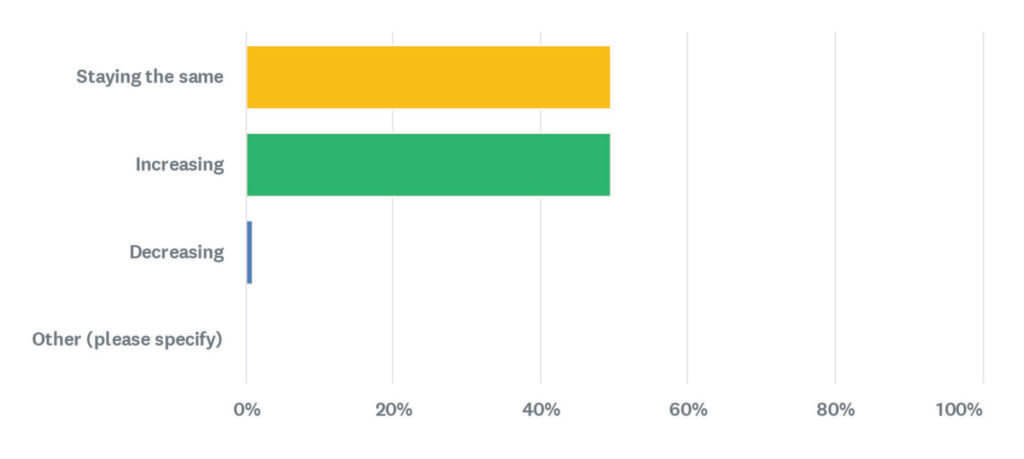
We began by asking readers how they expect their use of multi-asset solutions to change over the next 12 months.
The response was strikingly balanced. As shown in Fig.1, just under half (49.6%) expect their usage to stay the same, while an identical 49.6% anticipate increasing their allocation. Only one respondent, less than 1%, expects to reduce usage. In other words, virtually no one is stepping away.
That level of stability is significant. In an environment affected by shifting market conditions, evolving regulation and ongoing cost scrutiny, advisers are not retreating from multi-asset solutions but instead are doubling down or maintaining conviction. It suggests that multi-asset has moved beyond being a tactical tool and has become a structural part of many firms’ long-term investment structures.
A diversified toolkit, not a single approach
We also explored which types of multi-asset solutions are currently proving to be most popular. The results show that blended active/passive portfolios came out on top, accounting for 29.7% of responses (with readers able to select multiple options). Risk-targeted multi-asset funds followed closely at 26.3%, with risk-rated MPS just behind at 25.6%. Sustainable or ESG-focused multi-asset solutions accounted for only 16.2%.
As the data indicates, advisers are clearly comfortable working across different multi-asset formats and models, tailoring solutions depending on client objectives, investment frameworks and platform preferences.
That’s a sign of sophistication and indicates that multi-asset investing has matured into a flexible toolkit, capable of serving different segments of a client base rather than a ‘one-size-fits-all’ solution.
The active versus passive debate? Mostly settled
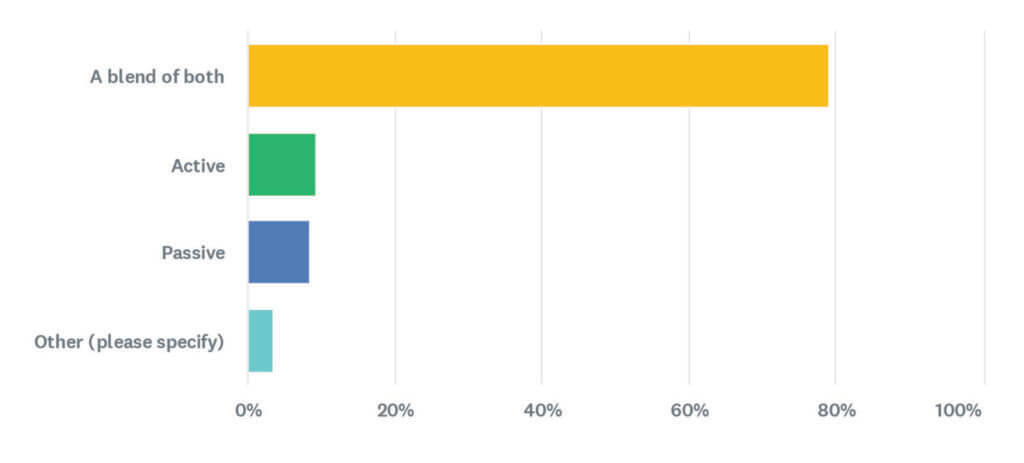
Perhaps one of the most telling findings relates to the active versus passive question.
As shown in Fig. 2, nearly 79% of readers say they use a blend of both active and passive multi-asset solutions. Just 9.2% use purely active, and 8.4% purely passive. This shows the approach to multi-asset investing is pragmatic rather than ideological.
The old binary debate seems to have softened. Advisers are not choosing sides; they’re selecting tools based on client suitability, cost efficiency, risk control and outcome alignment and seeing a place for both active and passive approaches in their solutions.
This blended mindset arguably underpins the resilience of multi-asset investing. It allows advisers to adapt to different market conditions without overhauling their entire investment proposition.
Provider diversification remains healthy
When it comes to the number of providers advisers work with, it appears that the majority are maintaining sensible diversification.
Almost 59% of respondents use between two and five providers for multi-asset solutions. Around 22% rely on a single provider, while 19% use more than six.
This suggests that while multi-asset is embedded in many firms’ propositions, advisers are not becoming overly concentrated. They are balancing conviction with due diligence, building relationships, but maintaining choice.
The provider list itself reflects a competitive and well-populated market. Beyond the named options, advisers also cited a wide range of additional providers, reinforcing the diversity of the marketplace.
What does this tell us about adviser sentiment?
Taken together, the results suggest three things.
First, multi-asset is firmly embedded. Advisers are not retreating from these solutions. Nearly half expect to increase usage over the coming year, and almost none anticipate reducing exposure.
Second, flexibility is the norm. Advisers are blending active and passive approaches, working across different structures and maintaining provider diversification. Thee market is nuanced and adaptable.
Third, engagement remains high. Even where advisers haven’t yet adopted specific solutions, there is an appetite for information and comparison. Advisers may already have established multi-asset relationships in place, but that doesn’t mean the door is closed. In fact, it points to the fact that competition, innovation and pricing remain key differentiators in this space.
In many ways, this reflects the broader shift within advice firms over the past decade. Centralised investment propositions have become more structured, governance-driven and outcome-focused. Multi-asset solutions, by design, align well with that framework. They offer scale, oversight, asset allocation discipline and cost visibility, all attributes that matter in a regulatory environment increasingly focused on value and suitability.
Commenting on the survey findings, Jamie Fowler, Head of UK Wealth, Schroders, said: “Advisers’ responses underline just how embedded multi-asset solutions now are within centralised propositions – and it’s encouraging to see confidence holding up, with almost half expecting to increase usage over the next year. In my view, that resilience reflects a simple reality: clients still need diversified portfolios that can adapt as markets and correlations shift. What also stands out is the pragmatic approach to implementation. The strong preference for blended active and passive solutions suggests the industry has moved beyond ideology and is focusing on outcomes, governance and value. In that context, active management remains important – not as a ‘style choice’, but as a way to be selective on risk, manage drawdowns and respond to changing opportunities across asset classes.
“At Schroders, we’ve been managing diversified portfolios for decades, and our Schroder Global Multi-Asset Portfolios are designed to provide a core, actively managed and low-cost solution. Backed by our global multi-asset investment teams, they combine disciplined portfolio construction with robust risk management and the flexibility to adjust as conditions change – supporting advisers who want solutions that are well-governed, transparent and focused on delivering client outcomes.”
A quietly strengthening trend
The consistency of adviser usage of multi-asset investment solutions tells its own story. This isn’t a fleeting trend, but it has become a core part of how many firms deliver diversified outcomes for clients. And with almost half of respondents planning to increase their allocation over the next 12 months, the direction of travel appears steady and positive. In a world and profession that continues to grapple with complexity and volatility, investment solutions that offer structured diversification and pragmatic flexibility are likely to remain central to adviser propositions for the foreseeable future.
This feature is brought to you in partnership with Schroders.
Survey information
This IFA Magazine readers’ survey received 119 completed responses and ran online from 10th to 23rd February 2026.
Click here to find out more about Schroders