Despite record levels of clean energy investment and accelerating deployment of renewable technologies, many transition-related stocks have disappointed investors. According to David Harrison, Head of Sustainability at Rathbones Asset Management, that reflects a mismatch between market expectations and the reality that the transition to net zero will play out over decades rather than market cycles.
Harrison says the route to net zero will be volatile, uneven and heavily dependent on long-term capital investment and investors risk misreading the energy transition if they judge it over too short a time horizon.
While progress towards net zero remains uneven, deployment of renewable energy technologies and electric vehicles continues to grow globally.
Harrison said: “The direction of travel is clear, but investors should not expect the transition to net zero to be linear. A strong structural theme does not always translate into positive short-term share price performance.”
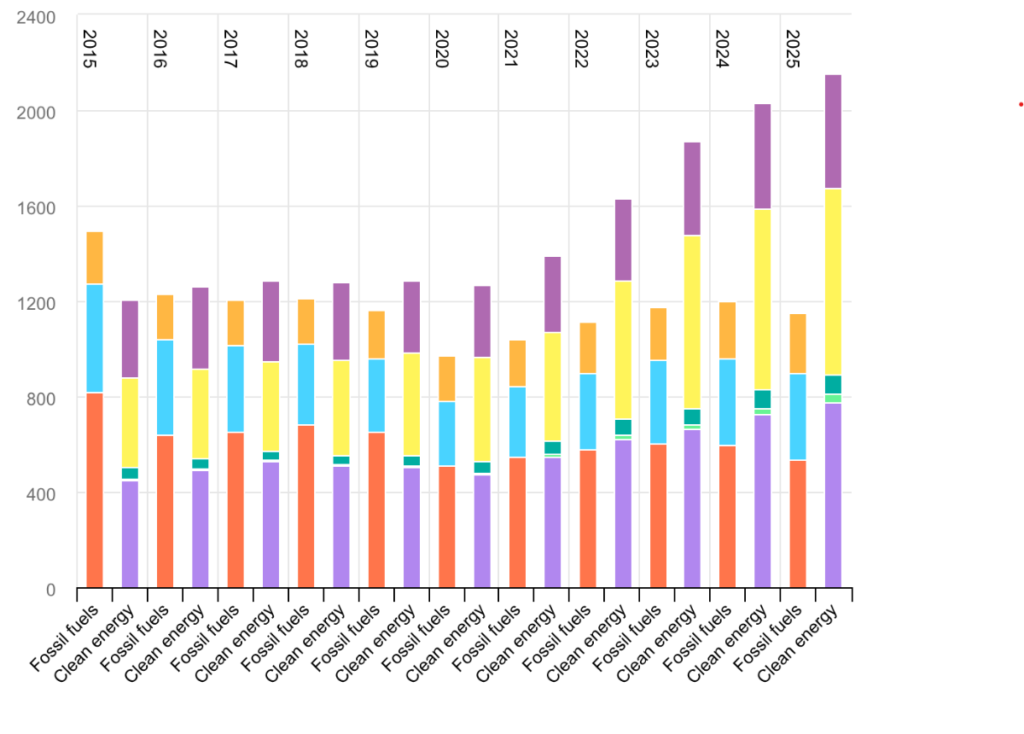
International Energy Agency data shows clean energy investment has accelerated since 2020 and is expected to attract significantly more capital than fossil fuels in 2025. Yet many clean energy equities have experienced considerable volatility and disappointing returns over the same period, underlining the gap that can open up between long-term structural progress and shorter-term market expectations.
Global investment in clean energy and fossil fuels, 2015-2025 (source IEA)
Taking a multi-cycle view
Harrison added: “Taking a long-term view is an essential part of investing. Investors need to focus on the fundamentals of a business, understand the structural trends that might help or hinder the investment case, and make sure they are paying the right price.”
For Rathbones Asset Management, that means approaching the energy transition through fundamental stock picking rather than simply buying the most obvious clean energy names. The firm focuses on companies with durable competitive advantages, attractive returns on capital and a clear role in enabling decarbonisation.
Harrison said this approach often leads the team towards ‘picks and shovels’ companies that are diversified globally and can evidence strong cashflow through the cycle, rather than pure-play renewable businesses that may not fit the same investment criteria.
“We have continually refined our approach and learned from our mistakes,” he said. “Once we own a company, we revisit the checklist over time to make sure something has not changed. The energy transition is a powerful long-term theme, but investors still need to be selective.”
Finding opportunity beyond the obvious names
One example is Schneider Electric, which Rathbones Asset Management views as a key solution provider to electricity companies globally. The business has a broad portfolio spanning product and digital solutions and is highly embedded in the energy transition, including in areas such as energy storage, which is becoming more important as renewable power sources grow.
Harrison said: “Schneider Electric is not necessarily a brand investors see every day, but it is highly embedded in the energy transition and generates consistent economic returns from it. That is exactly the sort of business that fits our checklist.”
Rathbones Asset Management also owns Linde, the industrial gas business, which has been held in the fund since 2018. Linde installs hydrogen power technology solutions for energy companies and has scale and execution advantages that Harrison says few competitors can replicate.
“Linde can look like an unusual choice for a sustainable fund because it works with carbon-intensive customers,” Harrison said. “We take a different view. It is a key decarbonising solution provider, it has proven it can operate at scale, and management has been consistent in articulating its sustainability strategy over time.”
Electric vehicles remain another important part of the transition, but Harrison said finding the right way to express that theme in a portfolio can be challenging. The auto sector is cyclical, often characterised by low margins, and few brands sustain a competitive advantage for long periods.
Instead, Rathbones Asset Management focuses on companies providing critical infrastructure for vehicle electrification and active safety. Aptiv, another long-term holding, has divested lower-margin divisions and now has a portfolio of products that regulate power in vehicles and improve battery efficiency.
Harrison concluded: “Aptiv is another example of a business that is firmly entrenched in the energy transition ecosystem without necessarily being a household name. The transition will continue to create opportunities, but they will not all be obvious, and they will not all work over a three-to-five-year timeframe. This is a multi-cycle investment theme, and it needs to be treated as one. The energy transition should be measured in decades, not market cycles.”
![[UNS] celebrate](https://ifamagazine.com/wp-content/uploads/2024/11/jason-leung-Xaanw0s0pMk-unsplash.webp)