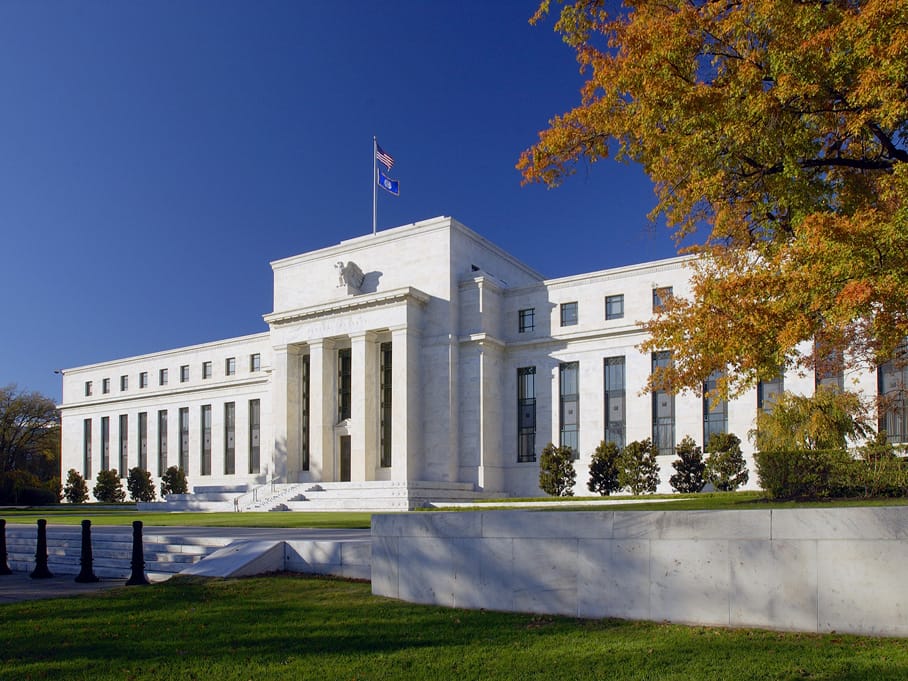
As was widely expected, it’s been announced today that the US Federal Open Market Committee (FOMC) voted 11-1 to leave US interest rates unchanged after its March meeting, keeping the target range at 3.5%-3.75%.
While US inflation is creeping higher, above the FOMC’s target rate of 2% ( although it’s been above that level for five years now), plus the US jobs market weakening, the Fed still reiterated its expectation for one further interest rate cut during 2026 in its post-announcement statement. Market watchers may question this stance, given the ongoing conflict in the Middle East and the implications for inflation spikes given the sharp rise in global oil and gas prices, the impacts of which are already being felt worldwide.
Interestingly, given the departure of Jerome Powell when his term ends in May, means that his successor, Kevin Warsh, might be facing some interesting challenges as he is widely expected to want to press for rate cuts.
What are industry experts thinking about the latest US interest rate data? They are of huge importance not just for US and Global stockmarkets but also for the ongoing health global economy. With the Bank of England’s MPC due to report tomorrow, it’s clearly a change from the direction in which market watchers had previously been seeing for interest rates this Spring.
Experts have been sharing their reaction to the US interest rate news with us as follows:
Lindsay James, investment strategist at Quilter comments: “Following a run of disappointing data prints, the Federal Reserve has once again opted to hold interest rates at today’s meeting, and its latest dot plot still points to just one rate cut this year. The US economy shed 92,000 jobs in February when markets had expected a gain of around 55,000, and while adverse weather and strike action played a part, the pain was felt across a range of industries. We also saw Q4 GDP revised down sharply, with growth now estimated at just 0.7% rather than the initial 1.4%. However, the economic projections that accompanied this statement highlighted that the Committee has increased its expectations for GDP growth in each of the next three years.
“Ordinarily, this combination of softer growth and a weakening labour market would tilt the balance towards a rate cut given the Fed’s dual mandate requires it to consider both price stability and maximum employment. However, the surge in oil prices has been the fly in the ointment.
“Central banks typically look through short term oil price volatility as while it can lead to higher prices for some goods and services, it also tends to act as its own brake on the economy, dampening the inflationary impact. This time, however, the closure of the Strait of Hormuz, the scale of the resulting price shock, and the uncertainty over when supply routes will fully reopen mean the Fed cannot afford to dismiss the inflationary risk so easily.
“Just one of the Trump appointed Committee members, Stephen Miran, continued to vote for an immediate cut, while the remaining voters told a more cautionary tale. Attention will soon shift to the possible arrival of Kevin Warsh later in the spring. He is set to inherit a committee that has been deeply split between hawks and doves, and it is unlikely that he’ll be a unifying figure given he’ll have argued for cuts in order to be appointed in the first place. There is a real possibility that later in the year we could see the unusual situation of an incoming Chair voting for a cut that does not receive majority support.”
Max Stainton, senior global macro strategist at Fidelity International, comments: “In the press statement, the Committee (FOMC) made clear that geopolitical risks add an increased layer of uncertainty to both sides of the mandate, but other than that, there was little change to the consensus-driven statement. Indeed, little change was the order of the day, with a small 20 basis point increase in core inflation expectations, which wasn’t mirrored on the interest rate side resulting in a modestly dovish tilt. However, the shift to a single dovish dissent, versus the two or three expected, added a slightly hawkish nuance. Taking it all together, the sense is of a committee constrained by uncertainty, waiting for events in the Middle East to unfold.
“In the press conference, Chair Powell attempted to provide a measured and calm set of forward guidance emphasising the need not to overreact to current events, noting “it’s too soon to know how these will affect the data”, and emphasising exceptionally high uncertainty. He instead placed emphasis on maintaining inflation credibility, particularly through the lens of inflation expectations. Chair Powell also made clear that the Committee is comfortable taking a wait-and-see approach as the impact of the conflict unfolds, while placing greater weight on the need for goods inflation to slow meaningfully over the year. He was explicit that any bias towards easing remains conditional on that progress materialising.
“Looking ahead to the rates outlook for the rest of the year,this will unsurprisingly be dominated by developments in the Middle East. In our base case scenario of oil prices remaining elevated but rangebound at $90-$110/bbl, we would expect the Federal Reserve to remain on hold for longer, with the bar for near-term easing rising. That said, we do not think this environment, on its own, is sufficient to drive a renewed tightening cycle, as the growth drag should remain manageable and the shock is likely to have a one-time price effect, rather than being broadly inflationary.
“By contrast, a move into an upside tail risk scenario with oil prices above $120/bbl (a significant fat tail risk that is currently rising in probability) would create a materially more difficult policy backdrop. Such a sustained oil move would reinforce a higher-for-longer stance, particularly if transport and broader goods prices begin to reaccelerate alongside rising fuel costs. However, we would also expect the medium-term policy path to become less linear, as a deeper energy shock would raise the risk of demand destruction and recession later in the year.
Taken together, if our base case scenario plays out, then we would still expect one to two cuts from the Fed this year. But we would note that events are shifting rapidly in the Middle East with signs of escalation appearing after Iranian energy infrastructure was hit today, which, if this persists, almost certainly removes the chances of cuts this year.”
And Richard Flynn, Managing Director at Charles Schwab UK, said: “As expected, the Federal Reserve left interest rates unchanged at 3.5%-3.75%, with the decision taken against the backdrop of the ongoing conflict in Iran, which shows little sign of easing. Markets have also pushed back expectations for the first rate cut to the summer of next year, from two cuts previously anticipated in 2026. A key driver behind this reassessment is the sharp rise in energy prices linked to tensions in the Middle East, prompting investors to re‑evaluate the inflation outlook.
“Diminishing prospects for near‑term rate cuts run counter to President Trump’s calls for lower borrowing costs for households and businesses, as energy‑led inflation remains a credible risk. Attention is firmly fixed on energy markets, with fuel prices rising sharply for US consumers. Until there is greater clarity on how the conflict will unfold, expectations of an imminent rate cut remain firmly off the table.”
Harun Thilak, Head of Global Capital Markets North America at Validus Risk Management, said: “The Fed left rates unchanged, with Stephen Miran being the lone dissenter (who called for 25bp cut). While the statement highlighted that the developments in the Middle East will be monitored for their effects on the US economy, US GDP projections were revised higher, which was a marginal surprise. Inflation projections were also marked higher but perhaps not as large as market expectations (in light of the recent energy price rise). Overall, a balanced statement has led to a muted reaction in FX and rates markets, with roughly 23bp of cuts being priced in currently till end of 2026.”