Elvira Kuramshina, associate director of quantitative research at WisdomTree, traces how falling launch costs, private innovation and renewed government ambition have transformed space into a growing commercial market.
On 20 July 1969, humanity achieved what had once seemed impossible: landing people on the Moon. Fifty-seven years later, Apollo 11 remains one of the defining technological accomplishments in history and a powerful reminder of what ambition, scientific ingenuity and sustained investment can make possible.
From moonshot to launch market
The first space age began with the launch of Sputnik in 1957, continued with Yuri Gagarin’s first crewed orbital flight in 1961 and reached its defining moment with the Apollo 11 Moon landing in 1969. Apollo 17 in 1972 was the final lunar landing mission, and the United States began to pull back from the Apollo programme as budget pressures mounted. The emphasis then shifted from reaching the Moon to sustaining a long-term presence in low Earth orbit (LEO). That shift defined the next era of human spaceflight. The Space Shuttle, that flew 135 missions, was NASA’s key vehicle between 1981 and 2011 with five operational orbiters developed during that period: Columbia, Challenger, Discovery, Atlantis and Endeavour. The Space Shuttle helped lay the groundwork for the International Space Station, which has been the key platform for microgravity research and the growth of LEO economy.
On 21 December 2015 the historic event that irrevocably changed the space industry took place during 20th flight of Falcon 9. Its first-stage booster returned to Cape Canaveral and landed vertically, making it the first orbital-class rocket with a reusable booster. Subsequently, reusability and higher launch cadence have been central to SpaceX’s role in lowering the cost of access to orbit and accelerating the growth of the space economy (see Figure 2). SpaceX’s lower costs have also been driven by in-house development, extreme vertical integration and a high degree of automation previously unprecedented in the space industry, combined with a mission-driven culture and a highly motivated workforce. To put this in perspective, launch economics have changed dramatically. Using the standard cost-per-kilogram metric, NASA’s comparison puts the Space Shuttle at $61,720 per kilogram to low Earth orbit, Saturn V at $5,200 per kilogram and Falcon Heavy at $1,410 per kilogram, all in 2018 US dollars (Figure 1). SpaceX has therefore driven the cost of access to orbit far below the Shuttle era and even below earlier government-backed systems, helping make larger payloads, more frequent launches and more ambitious in-space infrastructure economically viable.
Figure 1. Launch cost to LEO for Saturn V, Space Shuttle, Falcon 9, and Falcon Heavy.
| System | Saturn V | Shuttle | Falcon 9 | Falcon Heavy |
| kg to LEO | 140,000 | 27,500 | 22,800 | 63,800 |
| Cost per launch, 2018 $M | 728 | 1,697 | 62 | 90 |
| 2018 $k/kg | 5.20 | 61.72 | 2.72 | 1.41 |
| Reference | Williams, 2016 | Pielke and Byerly, 2011 | SpaceX.com, 2018 | SpaceX.com, 2018 |
If space ambitions expand into mass-intensive projects such as orbital data centres, larger stations and lunar infrastructure, launch costs will need to fall much further. Some estimates suggest launch costs could fall further over the next decade, potentially into the low hundreds of dollars per kilogram. That is one reason Starship matters so much: SpaceX is developing it as a fully reusable system designed to carry more than 100 metric tonnes to orbit. Such a step-down in launch cost would be essential for making space-based power, compute and other mass-intensive use cases economically viable versus terrestrial alternatives.
Technological progress is taking place alongside a broader strategic shift. Space is becoming a national priority again, but it is no longer shaped by governments alone. It is increasingly a commercial launch market supported by private innovation, public ambition and falling costs, creating the foundation for larger and more economically viable activity beyond Earth.
The rise of new markets in Space
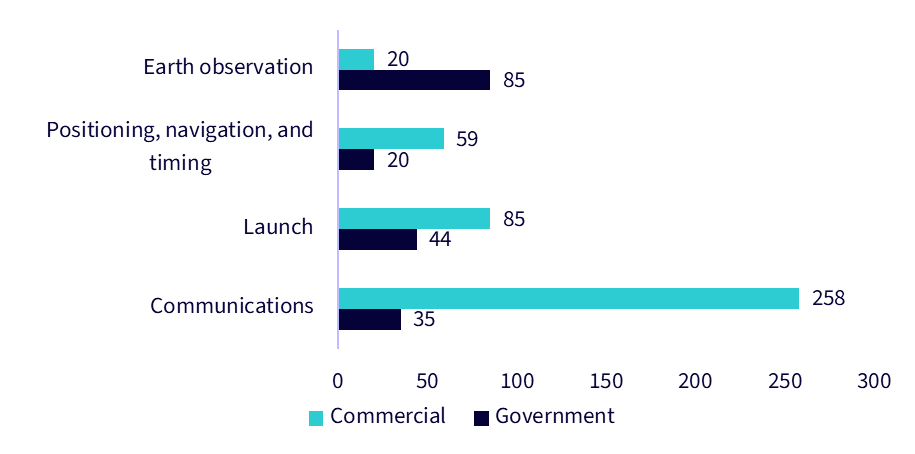
The next chapter of the space economy will be increasingly defined by infrastructure in space serving demand on Earth. McKinsey and the World Economic Forum estimate that the global space economy could grow from US$630 billion in 2023 to US$1.8 trillion by 2035. Today, commercial launches and satellites are the main engine of that momentum (Figure 2). Whether in agriculture, logistics, insurance, aviation, telecom, finance or government, organisations increasingly rely on space-based data and services to gain insights and access solutions that are not available from
Figure 2. Size of government markets vs. commercial markets by mission area, 2025-29 (forecast as of 25 August 2025), $ billion
The next wave of opportunity in space will come from uses that are only just beginning to emerge. Examples include extending the life of satellites already in orbit, removing defunct hardware, generating power in orbit, manufacturing high-value products in microgravity, operating orbital computing infrastructure, and, in time, building the first lunar installations and extracting resources from elsewhere in the Solar System. Most of these ideas are still at an early stage, and some remain unproven, but they point to a future growth trajectory and potential scale of the space economy. Space is becoming not just a place to reach and observe, but also a place to maintain, assemble and eventually produce, compute, generate power and extract resources.
Artificial intelligence and robotics are also becoming increasingly central to the next phase of the space economy. In the early space age, a range of robotic missions extended reach far beyond what human crews could safely achieve. Today, the frontier is shifting again: autonomous systems are helping spacecraft navigate, inspect, dock, repair and, in some cases, operate with far less human intervention. The farther we move from Earth, the more expensive, slow and complex direct human control becomes. AI and robotics therefore do more than improve efficiency. They make new missions, new services and eventually new infrastructure in space more practical, scalable and economically viable.
Continued technological progress, renewed government interest and the rising commercialisation of space are helping turn it into a frontier where launch systems, satellites, autonomy, robotics and in-orbit infrastructure are increasingly supporting activity beyond Earth. That is what makes the opportunity compelling: each step forward in access, automation and resilience expands what can be done in space, and the value it can create for industries on Earth.