After showing signs of recovery in the second half of last year, confidence among UK high net worth individuals (HNWI) has weakened once again, according to the latest Saltus Wealth Index Report published today.
The Saltus Wealth Index Report – now in its ninth edition and supported by Dr Michael Peacey of the University of Bristol – is the benchmark measure of HNWI sentiment in the UK, tracking the views of 2,000 individuals with investible assets of £250,000 or more.
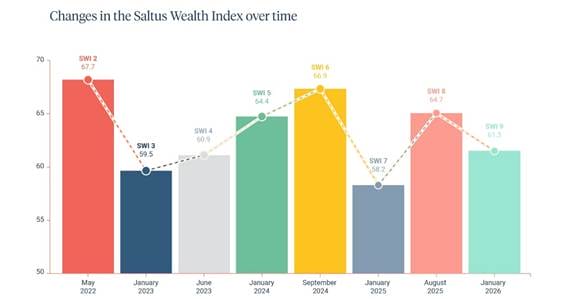
The latest Index stands at 61.3, down from 64.7 six months ago, confirming that the tentative rebound in confidence seen in September has not been sustained. While the Index remains above the record low of 58.2 recorded in February 2025, it is well below the peak of 67.9 seen in February 2022, highlighting the fragile nature of the recovery.
Economic confidence weakens as uncertainty returns
The fall in the Index has been driven primarily by declining confidence in the UK economy. Overall economic confidence has slipped from 66% to 59%, widening the gap with the 84% recorded ahead of the Labour Government’s first Budget in August 2024.
Almost a quarter (23%) of HNWIs now describe themselves as unconfident in the UK economy, rising sharply among older respondents, where 61% of over 65s say they lack confidence. This age divide is also reflected in views on the UK’s global competitiveness, with confidence that London will remain Europe’s financial capital over the next decade falling to 66% overall, and to just 32% among over 65s.
Tax and growth concerns dominate outlook
Concerns around taxation continue to weigh heavily on sentiment. Nearly half (45%) of HNWIs cite tax changes as a key risk to their personal wealth in 2026, second only to inflation (51%), while uncertainty around interest rates has risen to third place (30%).
Higher rates of Income Tax at 40% and 45% are viewed as unreasonably high by 22% of respondents, while 16% say Inheritance Tax is excessive. When asked about barriers to economic growth, HNWIs again point to Income Tax, Employer National Insurance and Corporation Tax, reinforcing the view that taxation on earnings and employment is acting as a brake on growth.
Confidence in personal finances eases
Confidence in personal finances has also edged lower. While a substantial majority (87%) of HNWIs still feel confident about their own financial position, this is down from 92% six months ago, returning sentiment to levels seen this time last year. Older respondents remain the least confident, with three quarters (75%) of over 65s expressing confidence compared with more than nine in ten (93%) of those aged 25–44.
Mike Stimpson, Partner at wealth management firm Saltus, said: “The latest data show that the tentative recovery in confidence we saw in the second half of last year has not been sustained. While sentiment remains above the lows recorded earlier in 2025, concerns around taxation, economic growth and political decision-making are once again weighing on HNWIs.
“Uncertainty over future tax policy continues to loom large. Whether it’s Income Tax, Inheritance Tax or changes affecting businesses and employers, HNWIs are clearly worried about the direction of travel and what further measures may be introduced.
“These individuals are investors, business owners and employers, and prolonged uncertainty risks dampening investment decisions at a time when the UK needs growth. Restoring confidence will require greater clarity and stability around tax and economic policy.”
Dr Michael Peacey, Senior Lecturer, School of Economics, University of Bristol, added: “The latest fall in the Index highlights just how fragile the recovery in confidence is proving to be. While sentiment improved temporarily in the latter part of last year, the data now suggest that underlying concerns have reasserted themselves, particularly around taxation and the wider economic outlook.
“The fact confidence jumped up and has now fallen back down again in just six months underlines the extent to which uncertainty has become embedded. This volatility reflects a combination of domestic policy concerns and broader global risks, including inflation and interest rate uncertainty.
“For confidence to recover more sustainably, HNWIs will need to see clearer signals on future tax policy and stronger evidence that economic conditions are stabilising.”