Lotfi Karoui, multi-asset credit strategist at PIMCO, examines the pressures still weighing on the software sector, from stretched valuations and uncertain recoveries to weakening support from private equity sponsors.
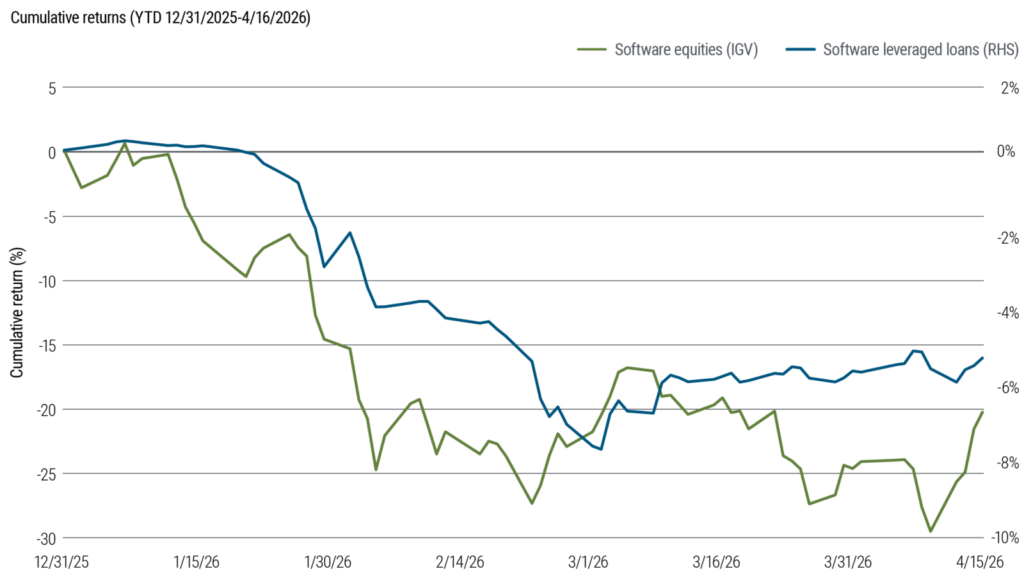
The software sector remains stuck in a trough across the capital structure. Software equities saw a meaningful relief rally last week but remain down about 20% year-to-date, while the modest March recovery in software leveraged loans has stalled (see Figure 1). Despite compositional differences – public equities generally represent larger companies with more scale, liquidity, and financial flexibility than the typically smaller, private-equity-owned issuers that dominate the software loan market – the outcome is the same: Neither market has been able to fully retrace the year-to-date sell-off in a meaningful way.
Figure 1: Software sector equities and loans remain near recent lows
Source: Bloomberg, PitchBook LCD, PIMCO as of 16 April 2026.
IGV references an index of North American software companies.
Public software equities are effectively long-duration assets (they typically pay no dividend and rely more on long-term cash flow expectations than other sectors), so the March backup in interest rates was not particularly helpful.
In credit, investors have historically leaned on the “sponsor put” – i.e., the ability of financial sponsors to support portfolio companies via add-on capital, debt buybacks, and other liability management tools – but that backstop has been less reliable this time.
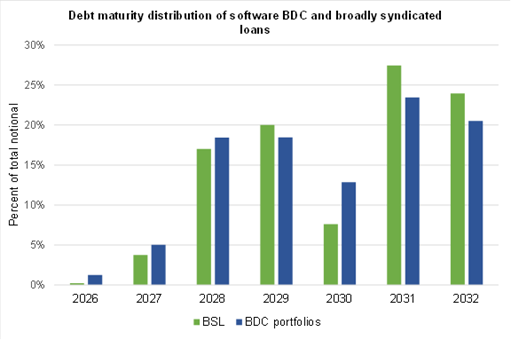
The good news is that relatively benign near-term refinancing needs for software companies limit the risk of an abrupt rise in financial distress (see Figure 2). That said, this is hardly a clean bill of health, and the fundamental challenges around terminal values are unlikely to dissipate anytime soon. An inflection in the broader business cycle would almost certainly turn latent, sector‑specific vulnerabilities into higher defaults over time.
Figure 2: Debt maturity walls for software borrowers in the leveraged loan and direct lending markets appear benign
Source: PitchBook LCD, PIMCO as of 31 March 2026
If a software‑led default cycle were to emerge, however, history offers limited direct guidance. The software sector as we know it today, characterized by loan‑heavy capital structures and significant sponsor involvement, has not experienced a meaningful episode of financial distress. As a result, empirical evidence on default intensity and recovery behavior remains scant.
That does not mean history is silent. There are precedents of industry‑specific shocks driven by technological change that resulted in asset obsolescence or excess supply. The rise of the internet and the ensuing print media defaults of the early 2000s illustrate the former, while shale production and the resulting energy sector distress exemplify the latter.
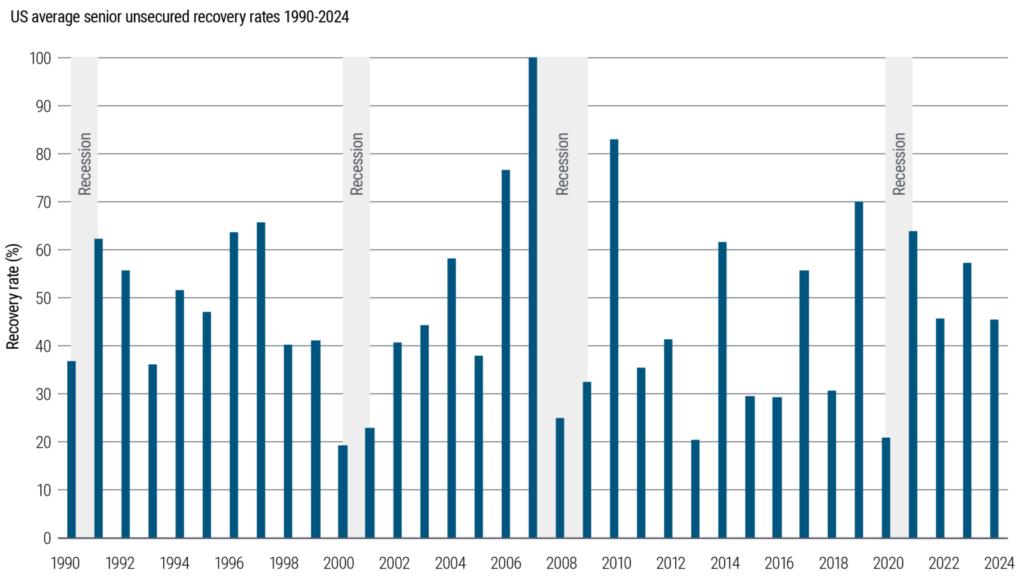
These episodes suggest a common pattern: When depressed residual asset values coincide with a concentration of distressed supply, recovery rates tend to be materially lower than average. Consistent with this, Figure 3 shows that recoveries during such periods, particularly in recessions, are notably lower than in low‑default environments.
Figure 3: Recovery rates tend to be lower when distressed supply is high, such as in recessions
Source: Moody’s, National Bureau of Economic Research, PIMCO as of 31 March 2026
Another look at dispersion in BDC portfolios
Valuation opacity in corporate direct lending portfolios remains front and center. Investors increasingly recognize that the smoother return profile over the past decade for this subset of private markets largely reflects lower observed volatility, not inherently lower risk. What is less appreciated is the extent to which opaque valuation practices and stale price marks have distorted the cross-sectional distribution of loan prices within BDC portfolios.
These practices have artificially compressed dispersion and created an appearance of stability that is not fully consistent with underlying credit diversity. This stands in sharp contrast to the broadly syndicated loan market, where continuous price discovery produces a wider, more informative range of outcomes across outstanding loans.
Two metrics underscore this gap. First, for loans held across multiple BDCs, the spread between the most conservative and most optimistic marks has widened meaningfully in recent quarters (see Figure 4). This divergence signals growing uncertainty around true valuations and has contributed to recent redemption pressures.
Figure 4: The spread between the most conservative and most optimistic marks in BDC portfolios finished 2025 at a new high
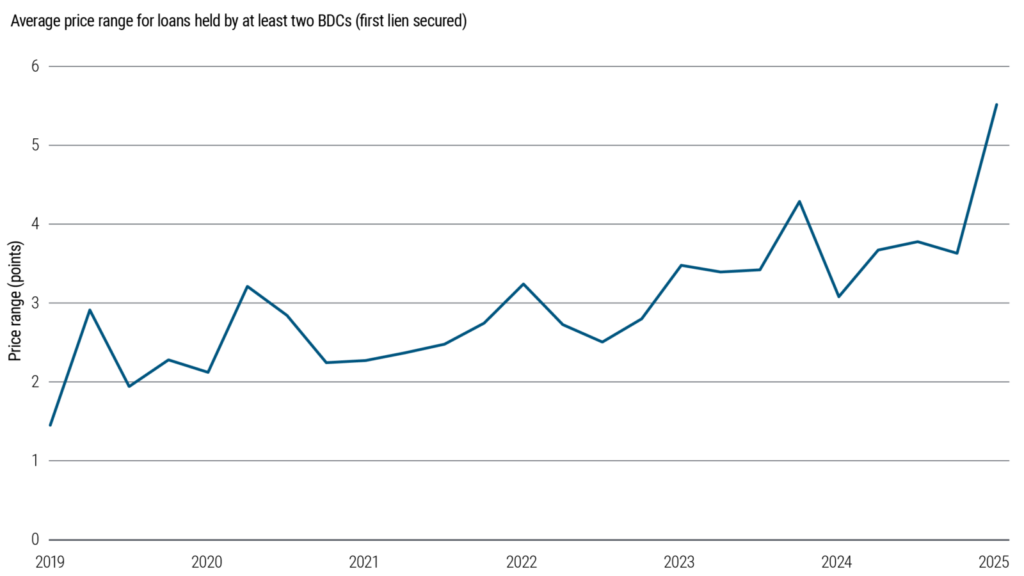
Source: PitchBook LCD, PIMCO as of 31 December 2025. The line represents the average range between the most optimistic (max) and most conservative (min) marks for loans held by more than two BDCs.
Second, since 2021 the overall price dispersion within BDC portfolios has been an order of magnitude lower than in the broadly syndicated loan market, leading to an implausibly tight range given broadly comparable credit risk (see Figure 5). In a stress scenario in which marks are forced to converge toward realizable value, dispersion would likely widen abruptly.
Figure 5: BDC portfolios show a much lower price dispersion than syndicated loans in recent years
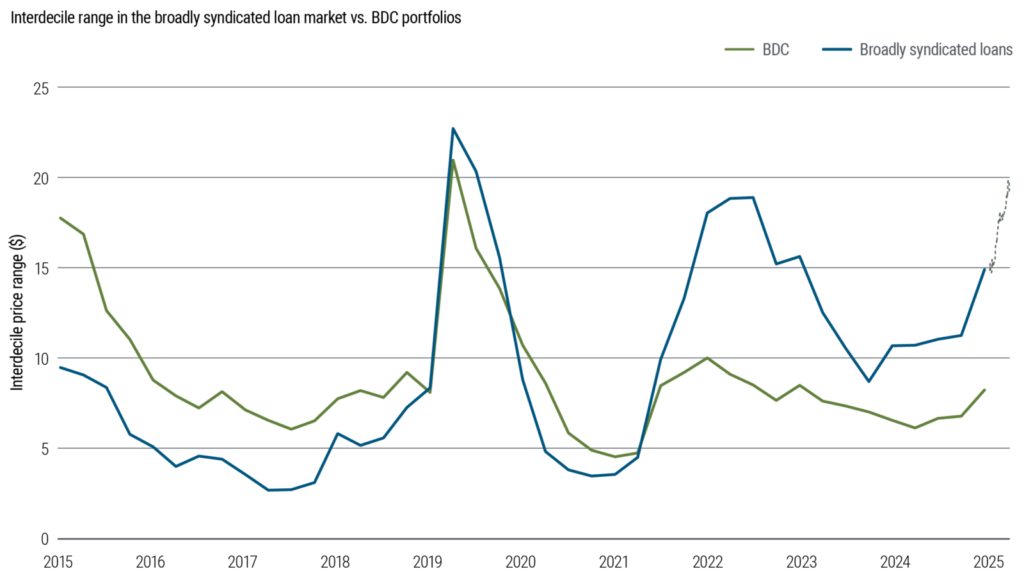
Source: PitchBook LCD, PIMCO. Data as of 8 April 2026. The dotted line shows BSL data from December 31, 2025 onward; comparable BDC data aren’t yet available because BDCs report quarterly.
Taken together, the software credit landscape looks stable on the surface but more fragile underneath. This argues for selectivity, a focus on downside mitigation, and caution toward strategies that rely on smooth reported valuations rather than resilient fundamentals.