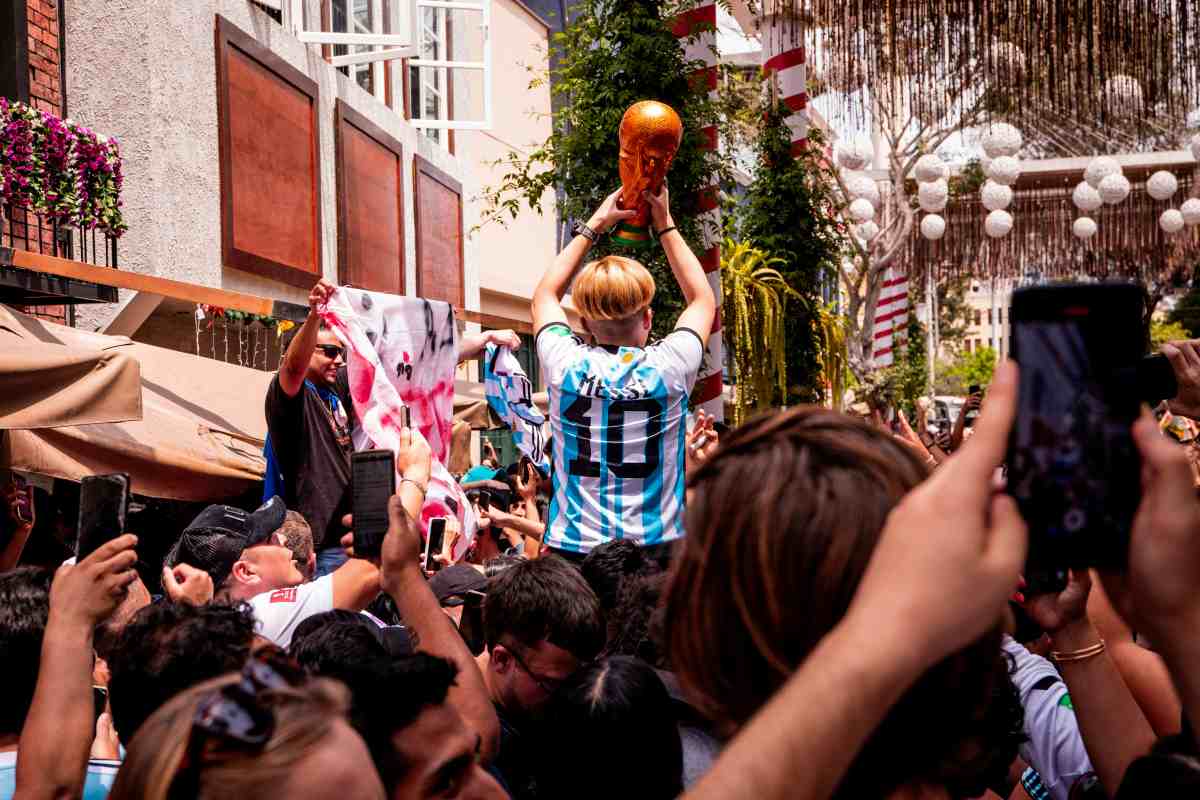
With many England fans possible feeling a tad jaded after a late night viewing their victory against Mexico earlier today, it’s clear that FIFA World Cup success may lift a nation’s spirits, but does it also boost its economy, if they end up as overall winners?
It’s a question that Michael Browne, Global Investment Strategist at Franklin Templeton Institute has been exploring for us. Sharing his latest insights with us below, Michael examines six decades of economic data to explore whether football’s greatest prize delivers lasting prosperity, or whether champions are more likely to face higher inflation, weaker growth and political headaches once the celebrations end.
Every World Cup arrives trailing a familiar promise: a burst of national optimism, packed stadiums, and — if the economists are to be believed — a modest bump to growth for the host nation. Much has been written about that host effect, with some studies suggesting a lift to GDP of around 0.48 percentage points on average. Whether a vast and already highly developed economy such as the United States will feel much of that uplift is open to debate.
Far less attention, though, has been paid to a more tantalising question: what does winning the World Cup do to the economy of the champion? So we decided to take a look. Not by comparing forecasts before and after a tournament — the data for that is patchy to the point of uselessness — but by examining what actually happened. We went back to 1966, partly because it offers a long enough run of tournaments, and partly because reliable pre-1966 data is scarce.
Since then, there have been 15 tournaments, four of them won by the host nation. It has also been an era of repeat champions. Germany, Argentina and Brazil have each lifted the trophy three times; Italy and France have won it twice; Spain and England once apiece. If football history over that period has been defined by dynasties, the economic record is rather less straightforward.
The economic dividend from victory is far from guaranteed.
What emerges is a picture that is more muddled than triumphant. In the three months after winning the World Cup, only two champions registered negative GDP growth. Stretch the horizon to 12 months, however, and that number rises to four.
Consumers, by contrast, seem to enjoy victory more consistently. Consumer spending increased over the following year in 12 of the winning nations, and car sales told much the same story. Industrial production was less upbeat, shrinking in five of the 15 winners over the subsequent 12 months. Yet business confidence, where data exists, rose in every case — nine out of nine. Winning, it seems, is good for the national mood even when it is less obviously good for the factory floor.
Inflation tells a different story altogether. In almost every case, price pressures accelerated between the three-month and 12-month mark after victory. The sole exception is Germany’s 1974 win, where inflation remained notably subdued despite the energy shock rattling the rest of the world — only underlines how unusual restraint of that kind is. That even Germany, hardly a byword for economic carelessness, stands out as the exception makes the broader pattern all the more striking.
Argentina’s three triumphs are the most dramatic examples, though it is worth noting that each occurred against a backdrop of deep, pre-existing macroeconomic dysfunction. Twelve months after each win, inflation had climbed to 16%, 110% and 211% respectively.
Unsurprisingly, foreign direct investment offers little evidence of a post-victory halo. In six of the 13 cases for which we have data, FDI fell over the following year, sometimes sharply. For all the emotional lift of sporting glory, winning over international capital appears a tougher ask.
Markets respond differently, with bonds often faring worse than equities.
The capital markets tell divergent stories. Ten-year government bonds delivered negative returns in five of the 12 cases we can track over the first three months after victory, and in six of 12 over a full year. Inflation, again, appears to be doing much of the heavy lifting.
Equities offer a similarly mixed, if ultimately more cheerful, picture. Over three months, six of the 13 winning markets posted negative returns. Over 12 months, however, only one did. If there is a simple investor’s takeaway from footballing success, it may be this: sell bonds, buy equities. But even that verdict comes with a note of caution because it is impossible to ignore the role inflation may be playing in the background.
Political leaders may find that sporting success creates unexpected electoral risks.
So winning the World Cup turns out to be a decidedly mixed blessing. The glow of victory can lift confidence and spending, but it also seems oddly prone to coinciding with faster inflation and, in a notable minority of cases, weaker growth. Four of the 15 champions recorded negative GDP growth in the year after lifting the trophy. Bonds, in particular, appear to dislike footballing glory over a 12-month horizon, while equities tend to recover their poise. The economic after-party, in other words, is not quite as carefree as the street parties and parades might suggest.
Then there is the political problem. On eight occasions, a general election followed within a year of the tournament. Only three of those contests were won by the incumbent government. For politicians, then, the World Cup may be less of a blessing and more of a trap: once the wave of euphoria subsides, it gives way to the return of inflation, dull economic reality and voter dissatisfaction.
The next champions could discover that victory comes with a hidden cost.
A quick look at the bookmakers’ current favourites makes this even more interesting. France faces elections in May 2027, Spain by August 2027 and Argentina in October 2027. Portugal and England complete the short-priced contenders, even though their next elections are not due until 2029.
If recent history is any guide, those in high office may have more reason to fear victory than celebrate it.
Who, then, would want to be a winner?













![[uns] business, handshake, appointment](https://ifamagazine.com/wp-content/uploads/wordpress-popular-posts/803862-featured-300x200.webp)