A year of political flashpoints, central bank change and geopolitical risk lies ahead for markets in 2026. Daniel Casali, Chief Investment Strategy at Evelyn Partners, outlines the key “known knowns” and “known unknowns” investors should monitor — and how they could shape currencies, equities, bonds and portfolios.
Daniel Casali, Chief Investment Strategy at Evelyn Partners, the UK wealth manager, commented:
“There are a number of market-sensitive events to monitor in 2026, though they fall into two categories. The first includes specific dates, where financial and currency markets could experience heightened volatility at a certain time, or as former defence secretary Donald Rumsfeld once put it as ‘known knowns’.
“The second category covers ‘known unknowns’. In Rumsfeld terms, these include events that could emerge unexpectedly and drive markets. We look at both categories and their potential implications.”
Here, Daniel Casali outlines what events to keep track of 2026:
The Known, Knowns
Fed Chair Change: Current chair Jerome Powell’s term is set to end on May 15, and President Trump has already signalled that he will announce a new successor. The two frontrunners are, according to betting website, Polymarket:
- Kevin Hassett: A former National Economic Council director during Trump’s first term, who is pro-growth and advocates aggressive rate cuts.
- Kevin Warsh: An ex-Fed Governor, who has been historically hawkish, but now appears aligned with Trump.
Regardless of who wins this ‘Battle of the Kevins’, Trump’s position is clear: cut interest rates fast. This could come at the expense of undermining the Federal Reserve’s independence and could weaken the US dollar further. Compounding this, a Department of Justice criminal investigation into Powell has raised questions about the Fed’s independence, as US President Donald Trump openly seeks greater influence over monetary policy.
Last year, the US dollar trade weighted index (DXY) fell over 9%, its biggest decline since 2003. Assuming US economic growth holds up, a weaker US dollar is likely to mean more money flowing into riskier assets, like stocks. However, it could lead to higher inflation and increase bond market volatility.
Nvidia’s earnings: Nvidia remains central to artificial intelligence (AI)-driven growth. Since ChatGPT’s launch in November 2022, Nvidia has consistently beaten earnings-per-share (EPS) estimates, though the margin between actual and expected has narrowed from +29% in mid-2023 to +4% in the last quarter. A miss could trigger a sharp correction in AI-related stocks and ripple through broader markets. The firm’s first quarterly financial results are due on the 25 February.
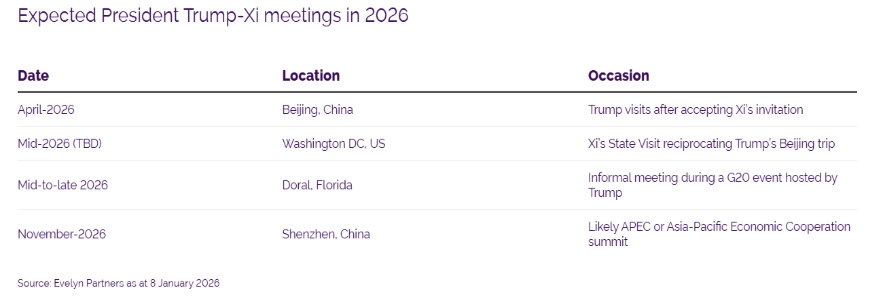
President Trump and President Xi face-to-face meetings: There are four potential meetings between the two leaders. Trump’s Beijing visit in April, Xi’s state visit to Washington mid-year, an informal G20 meeting in mid-to-late 2026, and the APEC summit in November. These discussions will likely centre on trade (tariffs, rare earths, tech supply chains), geopolitics (Taiwan, Venezuela, Russia-Ukraine), and security issues.
UK local elections on May 7: This is a key test for the Labour party. Poor results could spark a leadership challenge, especially with Prime Minister Keir Starmer trailing in polls. Ed Miliband remains influential among grassroots and unions, making him a credible contender. A shift toward a more left-leaning government could raise welfare costs that push gilt yields higher, especially at longer maturities.
The Known, Unknowns
A Chinese invasion of Taiwan: A Chinese invasion or blockade of Taiwan is a low probability, but high-risk event for investors. Taiwan dominates advanced semiconductor production, critical for technology and AI adoption. Any disruption would cripple supply chains, hitting global manufacturing and tech stocks. While the US and Europe are investing heavily, building capacity to match Taiwan is years away. Taiwan’s strategic location at the junction of major trade routes amplifies geopolitical stakes, as China seeks to expand its influence and the US pushes back with allies like Japan and South Korea. How the US responds would be critical, potentially, escalating risks dramatically. We may face surging volatility, supply shortages, and inflationary pressures, with tech and shipping sectors most exposed.
Oil price uncertainty from Venezuela and Iran: The recent capture of Nicolás Maduro from his Caracas palace by the US military, removed the leader of a nation with the world’s largest proven oil reserves – though Venezuela currently accounts for less than 1% of global crude supply. This is a reminder that the US will enforce its rights to intervene in Latin America to provide stability and maintain order, as laid out in the Monroe Doctrine.
A post-Maduro Venezuela could unlock significant investment and boost oil exports, adding supply to global markets. This would likely push crude prices lower, easing inflation and supporting global growth. So far, oil prices have barely reacted, suggesting limited immediate disruption. However, combined with unrest in Iran and potential risks to the Strait of Hormuz, short-term volatility in energy markets cannot be ruled out.
Russia-Ukraine potential peace deal: Recent reports indicate that Ukraine and Russia, under US mediation, are nearing a tentative peace framework shaped around a 20-point plan. Ukraine and its allies have settled around 90% of the proposal, primarily addressing US and European security guarantees and economic reconstruction. However, Russia remains noncommittal – the central obstacle remains the fate of occupied eastern Ukrainian territories. Kyiv has proposed the idea of demilitarised zones and economic autonomy, but they haven’t agreed to the formal cessions that Russia is asking for. The possibility of formal peace now rests on Russia’s response. Equity markets, particularly in Europe, are likely to benefit if peace is formalised.
Investor takeaways
This is already shaping up to be a year where events, and not just fundamentals, drive market volatility. Whether an event is known or unknown, the outcome from them all is not clear. Investors should prepare for heightened uncertainty. Portfolio diversification will be critical as markets swing between optimism and risk aversion in response to these pivotal events.


![[UNS] celebrate](https://ifamagazine.com/wp-content/uploads/wordpress-popular-posts/801986-featured-300x200.webp)