Conflict in the region has brought renewed market volatility and lifted oil prices, but well-diversified portfolios remain positioned to navigate the uncertainty.
Daniel Casali, Chief Investment Strategist at Evelyn Partners, the UK wealth manager, commented:
“Over the weekend, tensions between the US, Israel and Iran escalated materially. Israeli strikes have reportedly targeted Iranian nuclear facilities, while the US has signaled a broader objective that may extend beyond deterrence towards regime change. Iran has responded with attacks affecting parts of the Gulf region, including strikes impacting areas in the UAE, Qatar, Bahrain and Kuwait, as well as Israel. This marks a significant shift from previous contained flare-ups.”
Financial markets are responding to the risk of further escalation with three key price moves framing the immediate response:
- Brent crude oil is up roughly 10%, to around $80 per barrel
- S&P 500 futures are down approximately 1.5%
- Gold is up around 2.5%, reflecting demand for traditional safe havens
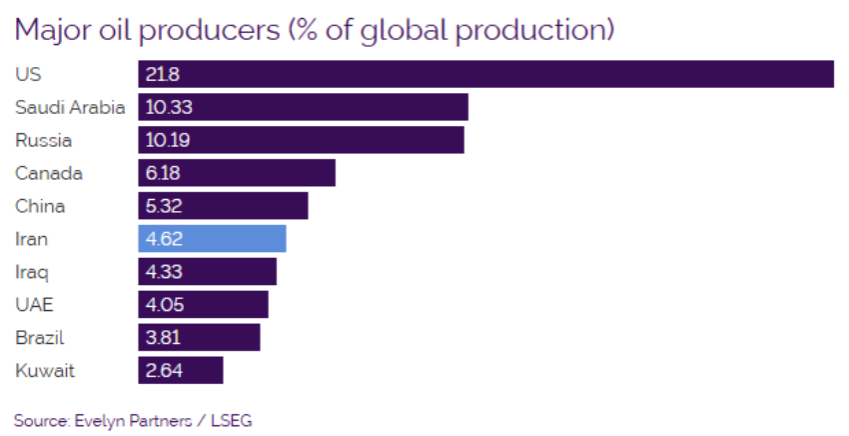
Casali added: “The move in oil is central. Iran is a major exporter, and critically, more than 80% of Iranian oil exports go to China. Iran is also strategically important to China’s Belt and Road initiative, is a member of BRICS and plays a role in facilitating trade outside Western sanction frameworks.
“In that context, this is not just a regional issue; it intersects with broader US-China strategic dynamics. Should the US gain greater leverage over oil flows coming out of both Iran and Venezuela, it would provide Washington with a significant bargaining chip ahead of the upcoming summit between Presidents Trump and President Xi of China. Paradoxically, such leverage could also deter China from blockading or invading Taiwan, a far larger systemic risk to global markets given Taiwan’s dominance in producing advanced semiconductors.
Key risks to watch
“The primary ‘tail risk’ remains disruption to the Strait of Hormuz, through which roughly a fifth of global oil supply passes. At present, while there are signs of disruption – including higher shipping insurance costs and some tanker hesitancy – the Strait remains open and traffic continues. A full closure or mining of the waterway would represent a far more severe shock to energy markets and global growth.
“There is also the risk of broader attacks on regional energy infrastructure or US-linked assets across the Gulf, as most of the key oil infrastructure sits within short-range missile range of Iran. However, at this stage, markets are pricing heightened uncertainty rather than a sustained supply shock.
“It is also worth noting that global oil inventories have been rising, which provides a partial buffer against near-term supply disruption. That does not eliminate risk, but it may dampen the impact unless escalation becomes materially worse.
“Equities have softened modestly, but earnings growth remains the dominant driver of equity markets. Corporate EPS momentum has so far offset geopolitical and tariff concerns this year, and we are not seeing signs of systemic stress or disorderly market functioning.
Portfolio implications
“Periods like this are uncomfortable, but they are not unfamiliar. We have seen similar episodes — most recently during prior Israel–Iran tensions and in the 2022 energy shock. History shows that while oil and gold often react sharply, diversified portfolios tend to prove resilient.”
Across asset classes, we are seeing natural offsets:
- Energy prices rise, supporting oil and gas equities
- Gold acts as a multi-use hedge during geopolitical stress
- Inflation-linked bonds, such as TIPS, provide protection should higher crude feed into inflation expectations
Casali added: “Within equities, exposure to energy producers can help offset broader market weakness linked to rising oil prices. In fixed income, inflation-linked bonds could benefit from rising inflation expectations. Alternatives such as gold continue to demonstrate their value during energy shocks, as seen in previous episodes including 2022.
“Our investment strategies are designed with periods like this in mind. They are constructed to withstand geopolitical shocks, inflation pressures and bouts of market volatility, while remaining fully liquid and aligned with clients’ long-term objectives and risk profiles.
“Looking ahead, we expect markets to remain volatile in the days ahead. News flow may be intense and, at times, sensational. It is important to distinguish between media tone and market fundamentals.
“At this stage, this is not a systemic market event. We are not seeing disorderly trading conditions or liquidity stress. For now, the appropriate stance for investors is calm, disciplined and long-term. Periods of geopolitical tension are unsettling, but diversified portfolios are designed to navigate precisely these environments.”



![[UNS] celebrate](https://ifamagazine.com/wp-content/uploads/wordpress-popular-posts/801986-featured-300x200.webp)