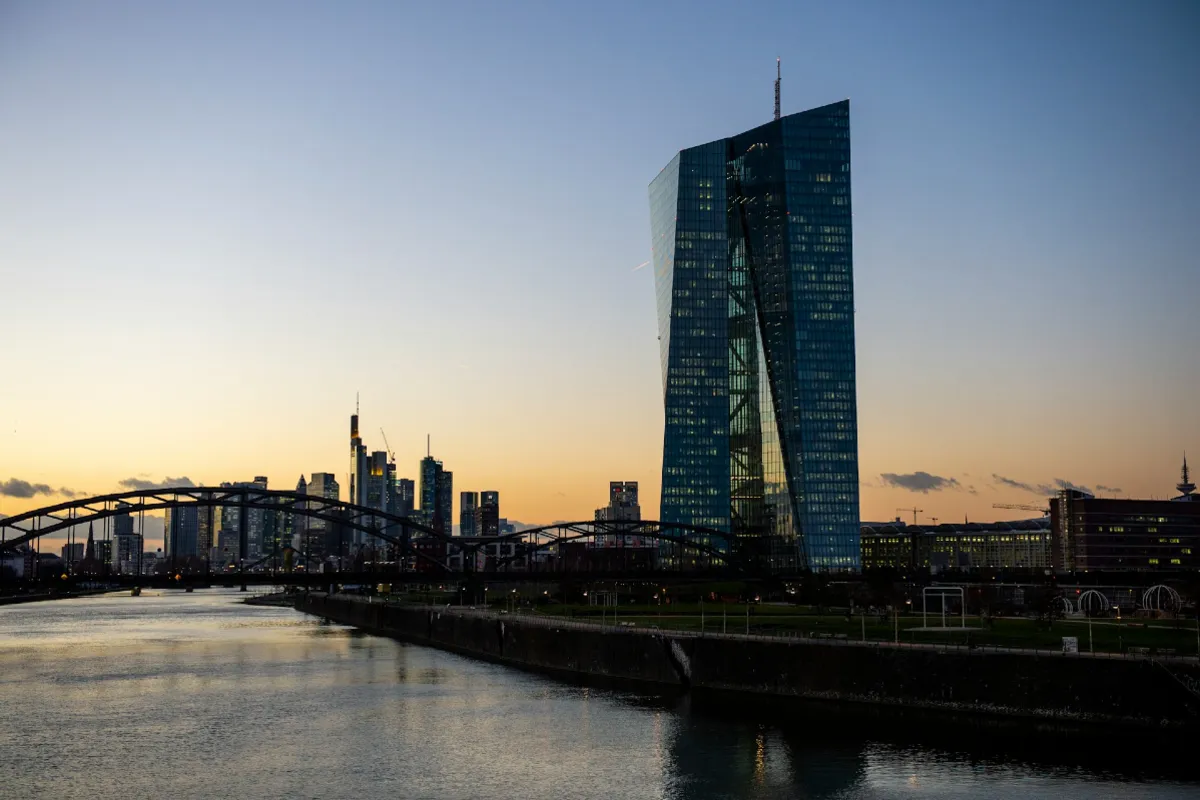
The ECB has left interest rates unchanged, opting for caution as it assesses the impact of rising geopolitical tensions and higher energy prices on the eurozone economy. While the decision had been widely expected, it comes against a backdrop of growing uncertainty, with concerns that renewed inflationary pressures could collide with already weak economic growth in the months ahead.
Experts are reacting to the ECB holding rates below:
Richard Carter, head of fixed interest research at Quilter Cheviot:
“As expected, the European Central Bank has kept interest rates on hold as it waits to assess the impact of the ongoing conflict in the Middle East. The ECB is well ahead of other central bank peers by having interest rates at 2% and inflation near enough at target, and as such has the space to adapt to the changing geopolitical picture. That said, events of recent years will be fresh in the mind of policy makers when they meet in the coming months.
“The ECB will not want to repeat the events of 2022, when the central bank was slow to respond to the inflation spike that came following the easing of Covid restrictions and Russia’s invasion of Ukraine. As a result, and given the headroom available, you could conceivably see the ECB make a move to raise interest rates once or twice this year to pre-empt any inflationary spike as a result of a sustained rise in energy prices.
“Of course so much of this is dependent on what happens in the Middle East and if Donald Trump can end this war claiming some kind of victory. But latest developments show no such de-escalation is coming and thus central bankers need to be prepared for the looming inflation spike. What may be difficult is finding what is the most appropriate level of action given the sluggish economic growth still being experienced in Europe. Any inflation spike will naturally act as a brake on economic growth, so it is important the ECB does not overtighten and keeps focus on the economic outlook. This is of course very difficult with such a moving picture in the Middle East and thus the outlook for interest rates is very much up in the air from here.”
Felix Feather, Economist at Aberdeen Investments, says:
“The ECB’s decision to keep rates at 2.0% comes as no surprise – a hold had long been telegraphed. But with oil and gas prices sharply higher, today’s decision was always going to be more about picking up clues as to the ECB’s reaction function going forward, rather than the decision itself. To that end, this afternoon’s release of scenario analysis and President Christine Lagarde’s press conference will provide more clarity.
“For now, the emphasis on upside risks to the inflation outlook in its decision statement and a 0.7ppt upward revision to 2026 base case inflation forecasts hint at the bank’s concern over renewed inflationary pressure, and its willingness to respond with hikes.
“We see the ECB hiking at least once by the end of this year. The pace and timing of these hikes will hinge on the duration of the conflict in the Middle East.”
Harry Woolman, Global Capital Markets Analyst at Validus Risk Management, said:
“Today’s ECB meeting was set to test their thesis of being in a “good place” and it certainly did that, with comments from policymakers acknowledging that the outlook is now “significantly more uncertain”. The decision itself, as expected, was to hold rates; however, the accompanying comments from the central bank will only add to near-term volatility, as markets ponder the ramifications of higher energy prices. Concerningly, the ECB also revised down their growth forecasts for 2026 and 2027.
Since the Middle East conflict began, we have seen an increase of over 60bp in the European two-year swap rates, as markets have bet aggressively on the next move from Christine Lagarde being a hike, rather than a cut. In fact, current pricing has a c. 50% chance of three 25bp hikes by year-end.”
Daniele Antonucci, Chief Investment Officer at Quintet Private Bank (parent of Brown Shipley) comments:
“The ECB, unsurprisingly, is keeping rates unchanged while highlighting that the Middle East conflict has introduced a new layer of uncertainty for both inflation and growth.
Higher energy prices are set to lift near‑term inflation, and the medium‑term outlook will depend heavily on how long the shock lasts and how deeply it feeds into consumer prices.
Inflation has been close to target, but the latest projections show upward revisions driven almost entirely by the energy channel.
At the same time, growth expectations have been pared back, reflecting the drag from commodity markets, real incomes and confidence, even though the resilience of labour markets and private balance sheets continues to underpin the baseline outlook.
The ECB is emphasising flexibility, relying on a data‑dependent and meeting‑by‑meeting approach in the face of evolving risks.
Longer‑term inflation expectations remain anchored, giving the ECB space to navigate uncertainty without committing to a defined rate path. Alternative scenarios underline that a prolonged disruption in oil and gas supply would push inflation above, and growth below, the central projections.”
Nicolas Forest, CIO at Candriam, said:
“The ECB is in an increasingly uncomfortable position. Escalating tensions in the Middle East, coupled with disruptions to energy supply, are once again clouding the inflation outlook in the euro area. After several meetings marked by a clear disinflationary trend, the recent rebound in oil prices and persistent geopolitical risks now pose tangible upside risks to inflation for the ECB. These pressures are likely to materialise not only through direct energy costs, but also via second-round effects on wages and services. At the same time, eurozone growth remains subdued, leaving the economy vulnerable to further shocks.
In response, the ECB has revised its inflation forecast to 2.6% for this year – up from 1.9% – and now expects inflation to remain above 2% through 2028. At the same time, growth has been revised lower to 0.9% this year (from 1.2%).
The central bank is therefore caught between two competing risks. On the one side lies credibility: after being widely perceived as too slow to normalise policy in 2022, the ECB is unlikely to tolerate a renewed inflation overshoot without responding. On the other is financial stability: past experience – most notably the 2008 rate hikes under Jean-Claude Trichet – demonstrates that tightening in a weakening macroeconomic environment can amplify market stress and downside risks.
Against this backdrop, the ECB’s reaction function is set to remain highly data-dependent, with no explicit forward guidance in an increasingly uncertain environment. However, a growing asymmetry is emerging: the bar for cutting rates is rising, while the threshold for tightening again – although still high – is no longer negligible. Echoing this shift, the Bank of England has signaled it stands ready to raise interest rates again to counter any inflationary pickup driven by the conflict in the Middle East.
This assessment will also be shaped by divergences among Governing Council members, as well as the forthcoming change in leadership.Markets are now pricing in slightly more than two rate hikes by year-end, with German yields adjusting accordingly. Much will depend, however, on the future governing council’s tolerance for deviations from the inflation target, the estimation of the second-round effects and its willingness to deploy the monetary policy toolbox.
Absent a sustained rise in oil prices above $100 per barrel and a prolonged blockage in the Strait of Hormuz, the ECB is likely to remain on hold through year-end. In this context, a Bund yield approaching 3% may increase the relative attractiveness of longer-duration assets.”




![[UNS] celebrate](https://ifamagazine.com/wp-content/uploads/wordpress-popular-posts/801986-featured-300x200.webp)