As spring turns to summer, investors are once again hearing the stock market adage “Sell in May and go away, and come back on St. Leger’s Day” where investors consider selling their holdings in May to avoid lower returns during the summer and autumn months, returning in November.
While catchy, history suggests that making investment decisions based on the calendar alone can risk missing what really drives long-term outcomes.
Aberdeen reminds investors they may benefit from stepping back and revisiting a few important lessons that markets have taught time and again but are often forgotten during periods of uncertainty.
- Income Matters More Than Many People Realise
When markets are growing slowly or moving sideways, income has often been a major contributor to long-term returns. Dividends from equities and interest payments from bonds have historically helped portfolios grow, even when prices themselves did very little. Over the long-term, dividends have accounted for around a third of the S&P 500’s total return1.
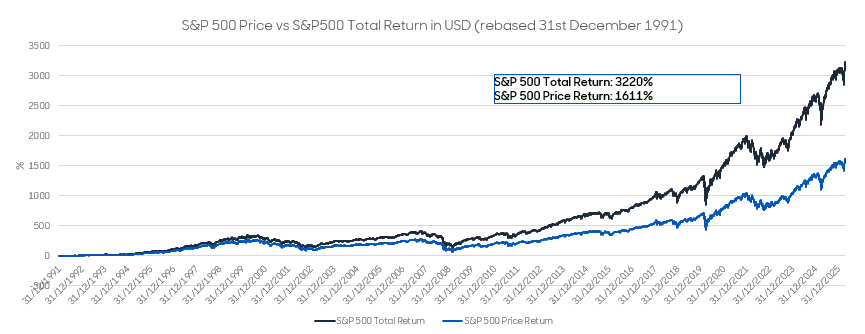
Source: Bloomberg, 29 April 2026.
Forgotten Lesson: Total return isn’t just about prices going up, it also includes the income your investments generate along the way. Holding a mix of income producing investments can make returns more reliable over time and help smooth the ride during volatile markets.
- Markets Often Bounce Back Faster Than Investors Do
After sharp market falls, such as those seen in 2008 and 2020, many investors sold at the worst possible time and waited for things to feel “safe” again before reinvesting. Unfortunately, markets don’t wait for confidence to return. Some of the strongest gains have historically occurred shortly after downturns, meaning time out of the market can be costly. For example, following the 2 April 2025 “Liberation Day” tariff announcement, global equities fell sharply, bottoming on 8 April, before quickly rebounding to regain their previous highs by 2 May 2025.
Forgotten Lesson: Staying invested over time has generally mattered more than waiting for certainty.
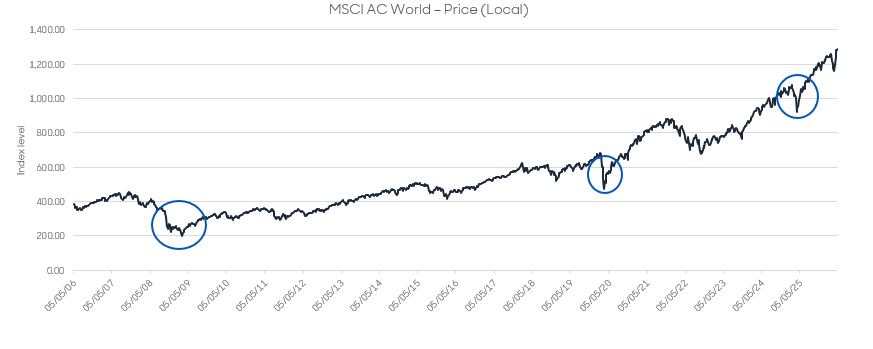
Source; FactSet, 28 April 2026
- When Everyone Owns the Same Thing, Risk Can Build Quietly
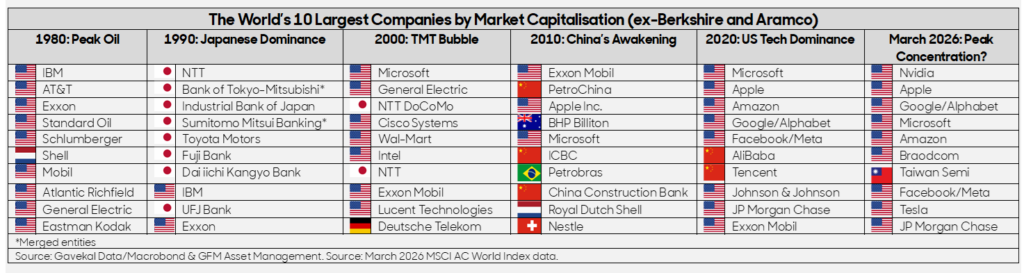
Markets go through phases where one country, sector, or style dominates. In the late 1980s, Japan made up almost half of the global stock market. In the late 1990s, technology stocks led the way. Today’s high concentration in a small number of large U.S. companies called the “Magnificent Seven” which alone account for about 20% of the global equity index2 is a reminder that what feels safe and obvious can also become crowded.
Forgotten Lesson: Diversification matters most when one part of the market feels unstoppable.
- Inflation Changes the Rules
Periods of high inflation, such as the 1970s, 2022 and more recently, have shown that markets don’t always behave as expected. Shares struggled, and bonds failed to provide the protection many investors relied on. When inflation shifts meaningfully, the usual relationships between assets can break down. For example, in 2022, both equities and bonds fell together, with the S&P 500 down around 18% and the Bloomberg US Aggregate Bond Index down roughly 13% in local terms3. This is why broader portfolios, which may include assets such as infrastructure or other real assets, can play a useful role.
Forgotten Lesson: Inflation changes how markets behave and old assumptions don’t always hold.
- Safe havens don’t always behave the same way
Recent geopolitical shocks, such as Middle East tensions driving oil prices higher and lifting inflation expectations, have shown that even perceived safe havens can experience sharp price swings.
For example, gold has long been seen as a store of value and a way to protect capital during periods of stress. History shows this can be true over the long term, but the path is rarely smooth. Gold can fall just when investors expect protection most, in late March 2026 it fell almost 11% in a single week4, one of its sharpest short‑term declines in decades.
Forgotten Lesson: “Defensive” doesn’t mean “risk‑free”. You need a blend of defensives, not a single hedge.
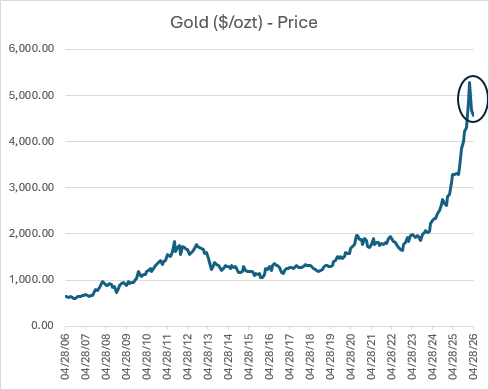
Source; FactSet 28 April 2026
Katie Trowsdale, Head of Multi-Asset Solutions, at Aberdeen commented; “Market phrases like ‘Sell in May’ are easy to remember and comforting in their simplicity, particularly during periods of uncertainty. But history suggests that long‑term investment success has rarely been driven by following the calendar. Instead, it has tended to come from staying diversified, remaining invested through market cycles, and adapting as conditions change. Time and again, markets have shown that income, diversification and patience often matter more than tactical timing, while even so‑called safe havens can behave unpredictably.
As investors consider their next move, it may be worth focusing less on catchy phrases and more on the lessons markets have repeatedly taught often during the moments when they are easiest to forget.”




![[UNS] celebrate](https://ifamagazine.com/wp-content/uploads/wordpress-popular-posts/801986-featured-300x200.webp)