As central banks continue to strengthen their gold reserves, official holdings have climbed above 36,000 tonnes, the highest level in 50 years.
Gold prices reached multiple record highs throughout 2025 and continued climbing into the first months of 2026. While some countries accelerated their purchases to strengthen and diversify their reserves, others took advantage of elevated prices to realise gains by selling part of their holdings.
To examine these shifts, the team at BestBrokers analysed the World Gold Council’s latest data covering the entirety of 2025 and the first months of 2026, identifying the countries that emerged as the world’s largest buyers and sellers of gold during this period.
Data indicates a growing concentration of gold within national reserve portfolios, with nine countries now allocating more than 80% of their total reserves to the metal. Venezuela remains the most heavily gold-reliant economy by a considerable margin, with gold accounting for 92.5% of its reserves, a proportion unchanged since 2018. It is followed by Uzbekistan (86.9%) and Bolivia (85.7%), while the United States (83.3%) and Germany (83%) complete the top five, both maintaining similarly elevated levels of allocation.
In the context of global reserves valued at €4.15 trillion, this concentration underscores the continued role of gold as a strategic reserve anchor for a select group of economies. The combined value of gold holdings among the top five countries stands at €2.12 trillion, while the nine nations exceeding the 80% threshold collectively account for €1.96 trillion, highlighting a deepening split in reserve strategies across central banks.
Here are the countries with the highest share of foreign reserves held in gold:
- Venezuela – 161.2 tonnes, 92.50% of total reserves, gold holdings currently valued at €18.29 billion
- Uzbekistan – 414.3 tonnes, 86.90% of total reserves, gold holdings currently valued at €47.01 billion
- Bolivia – 23.5 tonnes, 85.70% of total reserves, gold holdings currently valued at €2.67 billion
- United States – 8,133.5 tonnes, 83.30% of total reserves, gold holdings currently valued at €922.88 billion
- Germany – 3,350.25 tonnes, 83.00% of total reserves, gold holdings currently valued at €380.14 billion
- Lebanon – 286.8 tonnes, 81.20% of total reserves, gold holdings currently valued at €32.55 billion
- Kyrgyz Republic – 47.6 tonnes, 81.10% of total reserves, gold holdings currently valued at €5.40 billion
- France – 2,437 tonnes, 80.90% of total reserves, gold holdings currently valued at €276.51 billion
- Italy – 2,451.8 tonnes, 80.00% of total reserves, gold holdings currently valued at €278.20 billion
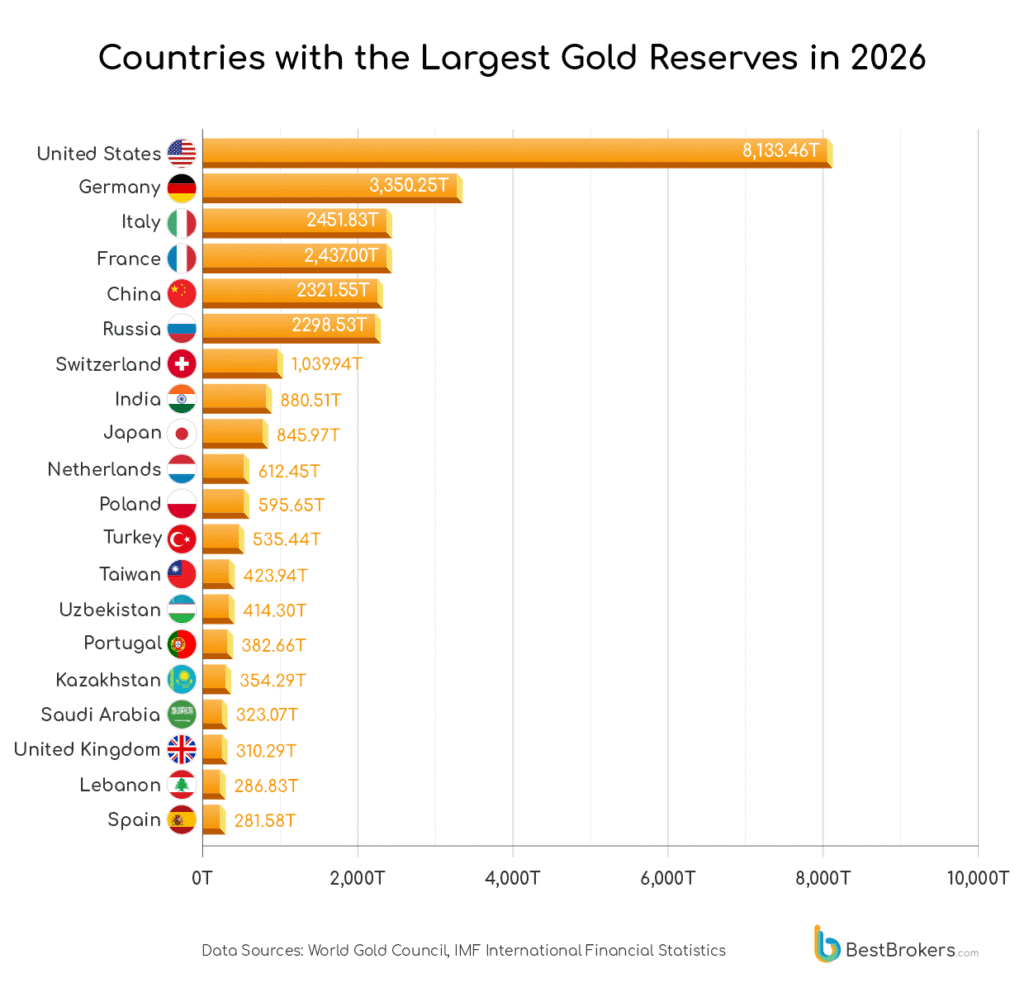
“The 2026 gold map is increasingly defined by divergence rather than direction: reserve managers are no longer moving together, but splitting into three clear behaviours – countries like Poland and parts of Asia accelerating accumulation to rebuild strategic buffers, advanced economies holding large but “frozen” legacy stockpiles with stable allocations, and a smaller group (notably Turkey and Russia) actively using gold as a liquidity tool and selling into strength. The result is a market where rankings are shifting not because everyone is buying or selling at once, but because each central bank is responding to entirely different macro pressures.”
Alan Goldberg, lead data analyst at BestBrokers.
![[UNS] celebrate](https://ifamagazine.com/wp-content/uploads/2024/11/jason-leung-Xaanw0s0pMk-unsplash.webp)