With uncertainty and geopolitical news driving increased market volatility in recent days, today’s early red screens have turned green as markets respond to the latest updates from President Trump in the late morning UK time on Monday.
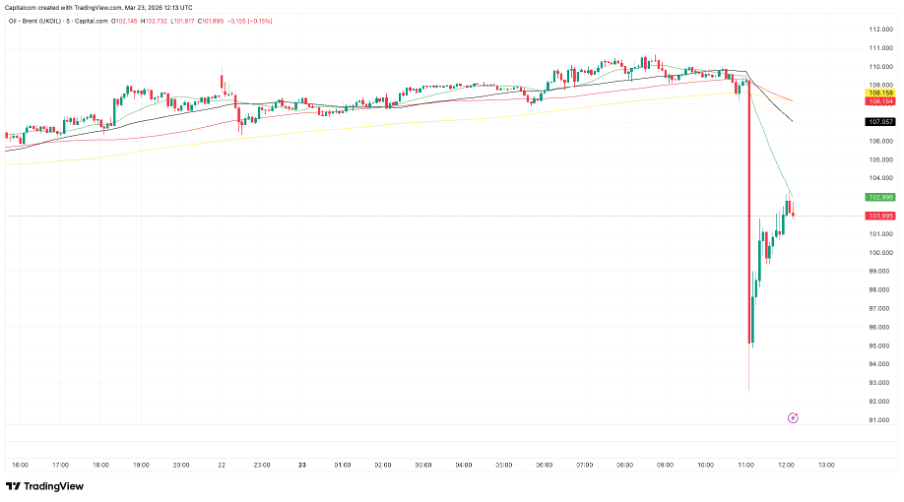
In his latest update, Trump indicated he was intending to postpone his threatened attacks on Iran’s power plants – unless Iran opened up the Strait of Hormuz and which caused such turmoil in markets– for five days. Share prices have surged after the statement, while oil and gas prices plummeted by way of a relief rally.
“This latest market moves perfectly capture just how fragile and headline-driven this environment has become”says Capital.com’s Daniela Hathorn, as she shares her analysis of today’s important market moves.
“President Trump’s post suggesting “productive conversations” with Iran and a postponement of strikes triggered an immediate and aggressive risk-on reaction — equities surged, bond prices rallied, the dollar weakened, and oil prices dropped sharply as the perceived probability of a major escalation fell. At the same time, crude prices saw one of their sharpest reversals, dropping double digits intraday as traders rapidly unwound the geopolitical risk premium that had been building into energy markets.
“However, the equally swift denial from Iran that such constructive talks had taken place underscores the core issue: markets are trading narrative, not certainty. The initial move reflects positioning with investors heavily hedged for escalation quickly pivoted toward relief, triggering a violent unwind. But the fact that the move was partially reversed highlights how little conviction there is in any single outcome. This is not a market that believes a resolution is imminent; it is a market reacting to any sign of an off-ramp, however fragile.
“From a market structure perspective, this looks very much like a classic “TACO” dynamic with Trump signalling escalation, then stepping back when faced with the economic consequences. That reinforces the idea that the US administration is actively seeking an exit, even if the path to get there remains unclear. It also explains why the reaction is asymmetric: markets are far more sensitive to signs of de-escalation because positioning had already skewed heavily toward downside risk.
“In the near term, this does open the door for a relief rally as immediate tail risks are repriced lower. That would typically mean equities pushing higher, yields falling, the dollar softening and oil retracing. But the broader takeaway is that volatility is far from over. The underlying conflict remains unresolved, and until there is a credible, sustained de-escalation, markets will continue to swing aggressively between fear and relief on each new headline.”
Brent oil 5-minute chart
Tom Stevenson, Investment Director at Fidelity International, comments on today’s market reaction to Trump’s latest update saying:
“A dramatic U-turn by President Trump on Monday has triggered sharp swings in global markets. After early falls across bonds, shares, and precious metals, markets rebounded quickly when the White House suspended threats to attack Iran’s power networks via a post on Truth Social.
“European markets saw the clearest response. The FTSE 100, down as much as 2.5% in early trading, recovered into positive territory within minutes of the announcement. Germany’s DAX and other continental indices also bounced back, reflecting relief that the immediate threat of escalation had eased.
“Bond markets reacted strongly. Gilts, which had seen yields spike above 5%, fell back as prices recovered, while the US 10-year Treasury yield dipped slightly to 4.4%. Oil prices fell sharply, with Brent crude dropping around 10% to $101 a barrel, following the easing of Middle East tensions. Gold also saw a modest rebound after earlier losses.
“Markets remain volatile, reflecting lingering uncertainty over US-Iran relations. Investors are balancing short-term relief with caution, mindful that the situation could change rapidly. Nevertheless, strong corporate earnings and hopes for a swift resolution have underpinned the rebound, highlighting the importance of diversification and a long-term investment perspective.
“The swings in equities and fixed income underscore the sensitivity of markets to geopolitical risks, especially in energy markets. Rising correlations between stocks, bonds, and commodities mean that safe havens are harder to find, but today’s moves show how quickly sentiment can shift when an immediate threat is removed.
“Overall, Monday’s trading illustrates the market’s agility in reacting to geopolitical news. While short-term gyrations can be sharp, medium-term fundamentals remain supportive, and investors who maintain a diversified portfolio are best positioned to navigate periods of uncertainty while capturing the longer-term benefits of equities and other growth assets.”
George Lagarias, Chief Economist at Forvis Mazars has warned investors to respond only to verified facts, as volatility hits the markets once more following the latest comments from Trump, saying:
“The volatility of asset prices faithfully mirrors the volatility of events in the Middle East, including competing, and conflicting, statements from Washington and Tehran. Despite the initial jump in risk assets, it’s becoming evident that the situation remains uniquely fluid. De-escalation is as much on the table as re-escalation. Investors should remain calm and respond only to verified facts and agreed upon deals. At the heart of the market volatility is free movement in and out of the Straits of Hormuz, a very important global trade chokepoint. Until investors get assurance of at least a medium-term resolution that would ensure the resumption of normal trade in the Persian Gulf, they would do well to remain reserved.”
Susannah Streeter, chief investment strategist, Wealth Club comments: “Markets have been taken on a wild ride, as investors have swung from deep pessimism to giddy optimism about the trajectory of the war with Iran. Clinging to President Trump’s words is fraught with risks, given how hopes have already risen and then been dashed over the last four weeks. Even if the US and Iran come to some agreement, bringing Israel fully on board may prove difficult given the nation’s renegade tendencies. Nevertheless, for now, sentiment has turned more upbeat after the US President claimed that two days of conversations aimed at a total resolution of the conflict were ‘good and productive’.
“Brent crude has dropped sharply, having jumped above $115 earlier, it fell below $100 a barrel before climbing higher again. At this level, energy costs will remain super-painful for companies and consumers. It’s clear that traders are still expecting significantly lower flows from the Middle East, even if a ceasefire is agreed, given the disruption to supply routes and the damage to facilities.
“Iran’s claim that Trump has ‘backed down’ is likely to add fresh uncertainty into the mix. The President will still want to project a strongman image and is unlikely to want any resolution to depict him in a weaker position on the global stage. Both sides in this conflict are proving to be unreliable narrators, and that’s still causing nervousness. There’s still high tension in the bond markets, with inflationary concerns not subsiding. UK 10-year gilt yields have swung sharply, dipping back but then climbing higher above 5% again as hopes for a fast resolution start to fade.”
Matthew Amis, Investment Director, at Aberdeen said; “The circuit breaker markets needed. The selling has stopped for the time being after a very weak start to the week. European sovereign markets, as you would expect, are reacting positively to the Trump headlines, despite the Iranian pushback. However, to materially unwind the moves of the last few weeks, we would need to see more than words and clear action: namely ships moving through the Straits of Hormuz. Markets still have aggressive hikes priced for the UK and Eurozone in 2026. Although we don’t agree with the level, for those to be removed we would need to see energy prices fall a lot further.
“Although this is merely a 5 day postponement, we believe today’s headlines at least show that de-escalation is possible. UK gilts have been beaten up over the last few weeks, with yields surpassing 5% on Friday we are therefore very tentatively buying UK Gilts.”
Oliver Faizallah, Head of Fixed Income Research at Charles Stanley, part of Raymond James Wealth Management, comments: “The sharp move in short-end Gilts last week does seem overdone, while some of the moves at the longer end seem more reasonable given the increased fiscal concern around the cost of defence spend and spend on household bill allowance amongst others.
“Prior to the escalation in the Middle East, UK inflation was forecast to fall to sub-2% over the next 12 months, growth remained tepid, and the labour market was showing signs of weakness. While rising oil prices will increase inflation, increasing rates from already restrictive policies would likely do little more than push the UK economy into a severe and prolonged recession.
“We have already seen reports of consideration of deescalation of the war from President Trump this morning, suggesting the US would like to end the conflict as soon as possible. This does not mean that the conflict will automatically stop, nor is it likely that oil prices fall back to pre-war prices, as Israel is not bound by US-Iran talks, which could collapse at any moment.
“Supply driven cost-push inflation remains a concern, and it is likely that the BoE will hold off on future interest rate cuts. However, given the fragility of the UK economy, we may see a softening of rhetoric from the BoE going forward, and a continued unwind of some of the aggressive sell-off seen at the short end of the gilt curve at the end of last week.”
John Wyn Evans, Head of Market Analysis at Rathbones, said:
“Trump’s decision to postpone further strikes on Iran has given markets a brief pause, but is not necessarily a meaningful step towards full de‑escalation. If anything, the delay underscores just how delicately balanced the situation has become. Both sides appear to be probing for advantage, and the signals coming out of Tehran suggest Iran remains willing to absorb significant pain rather than back down quickly. That alone differentiates this crisis from previous episodes where Washington has been able to ‘escalate to de‑escalate’.
“For investors, this creates an unusually asymmetric landscape. In normal times, equities tend to drift higher while we remain wary of sudden shocks. Today the dynamic is inverted: each day without resolution exerts a slow downward pull on markets, yet the potential for a sharp squeeze higher remains very real if there is even a hint of a credible ceasefire. Trump’s pause only reinforces that optionality, not because it increases the probability of peace, but because markets are conditioned to seize on any reduction in headline risk, however temporary.
“The more substantive concerns sit beneath the surface. Energy markets remain vulnerable, particularly refined products and natural gas, where supply disruptions are already feeding into higher input costs. Even if hostilities were to ease, damaged infrastructure and constrained shipping channels mean these pressures won’t unwind quickly. That feeds directly into inflation expectations, political pressure in the US, and ultimately the limits of how long Washington can sustain its current approach.
“Against this backdrop, patience and discipline remain essential. Our portfolios are built with these conditions in mind: resilient enough to absorb volatility, but flexible enough to capture opportunities when clarity finally emerges. This isn’t a moment for complacency – but neither is it a moment for panic.”
Markets on edge? Why diversification is your first line of defence.
Get expert guidance on MPS construction, asset allocation, and portfolio design by downloading IFA Magazine’s latest MPS Insights Publication and earn CPD HERE.




![[UNS] celebrate](https://ifamagazine.com/wp-content/uploads/wordpress-popular-posts/801986-featured-300x200.webp)