
Ben Barringer, head of technology research at Quilter Cheviot, looks at whether the latest tech sell-off signals an AI bubble or a more mature phase for the sector.
“With tech stocks selling off again, it is pertinent to question whether once again we are in the ‘tech bubble 2.0’, and if things are beginning to go pop. Back in October 2025, when this question was last being asked technology stocks, especially those at the centre of the artificial intelligence (AI) trade, were powering ahead and dragging markets higher with them.
“Things are different this time, with share prices coming under pressure, but certainly, at the headline level at least, little has actually changed. Despite a tough July, technology stocks have still comfortably outperformed wider markets since October and the sums being invested in AI. However, scratch beneath the surface, and the AI narrative has moved on. The huge amounts being spent on data centre capacity are not the only sums growing at pace. So too, are the AI-generated revenues of the big spenders. Usage of AI in the workplace has also soared. And while the technology sector as a whole has maintained its market leadership, at the stock level, the usual suspects, aka the Magnificent Seven (Alphabet, Amazon, Apple, Meta, Microsoft, Nvidia and Tesla), have not led the charge.
“Semiconductor (microchip) equipment manufacturers, memory chip producers and power chip companies have been the ones in demand. Revenue growth, rocketing usage and a switch in leadership, all point to an AI trade that is maturing.
Tech stocks have clearly outperformed since 2020
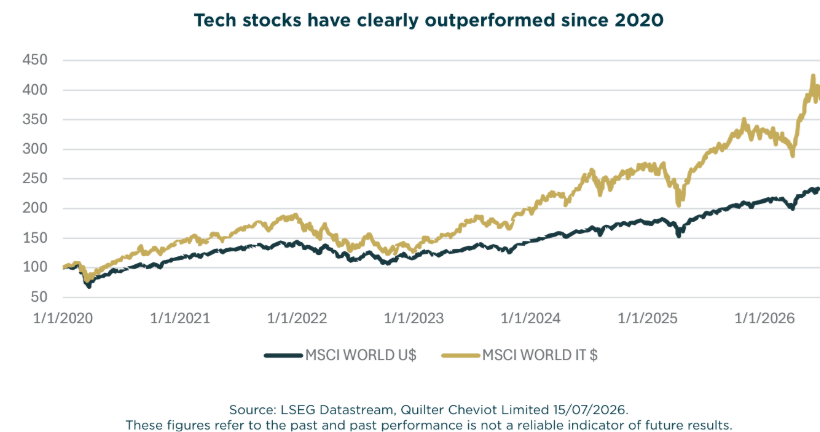
“Technology stocks’ outperformance is now in its sixth year. There have been wobbles along the way, but overall, enthusiasm for the AI-trade has come hand-in-hand with elevated volatility. What needs to be remembered is that we are still early in the AI journey. The key is to ensure reality and expectations match. Does what’s happening on the ground warrant the current market reaction? There are a number of metrics and developments investors should keep a close eye on:
- Growing AI-based revenues: Three out of the Big Four hyperscalers have extensive cloud businesses – Amazon, Alphabet and Microsoft – and all three posted stellar growth in cloud revenues in their recent results. Spending on data centres is leading to faster hyperscaler cloud growth. The benefits of AI are also showing up in digital advertising revenue growth, with the technology causing ad revenues to spike. Both Alphabet and Meta are using the technology to help advertisers maximise the returns they make on their investments by refining ad targeting and improving user engagement. This in turn is generating higher ad spending.
- Soaring token consumption: Revenue growth at the LLM developers is being driven by increased usage of AI by companies and their employees. The use of tokens (the basic units of output from LLMs), however, has grown to such an extent that companies are having to introduce caps on the amount of tokens their employees consume to keep a lid on costs. Companies will likely put guardrails around usage going forwards similar to the way cloud deployments were optimised around 2022. Lower corporate AI usage could impact the pace of revenue growth at LLM developers however we believe there is still considerable run room for increased adoption of AI.
- Broadening out of the AI trade: For much of the past five years, it’s been the Magnificent 7 Big Tech stocks that have led markets higher. Since the turn of the year, however, Nvidia and co have largely traded sideways. Instead, it has been other semiconductor stocks that have caught the eye, particularly memory companies such as Micron, Hynix and Samsung; semiconductor capital equipment companies such as ASML, KLA and Applied Materials and power chip companies such as Infineon. All those data centres being built require chips and lots of them.
- Trillion-dollar IPOs: The successful US$1.75trn market debut of Elon Musk’s SpaceX promises to kick off a spate of other trillion-dollar IPOs, notably those of Anthropic and OpenAI. The concern is that owing to the size of these new issues existing large and liquid tech names will face selling pressure as funds will have to be raised to acquire stakes in the newcomers. Importantly, however, SpaceX’s 5% initial free float and similar expected floats at Anthropic and OpenAI should limit the scale of any selling, and thus this fear looks overstated.
- Valuations: Bubbles are typically associated with high valuations. Although the technology sector trades at an approximate 20% valuation premium to the main US stock market, this premium reflects the superior growth available from technology stocks. Furthermore, tech valuation multiples are significantly below those seen at the peak of the dotcom bubble in March 2000.
“As with all transformative technologies, however, risks remain, and indicates why investors are favouring suppliers to the AI trade, rather than the tech itself. The AI trade is clearly showing signs of maturing, with investors now more focused on earnings and revenue growth rather than capex plans. While the trade comes under pressure, though, concerns about a bubble and its ability to pop will persist for as long as technology stocks continue to dominate the market. For as long as investors continue to prioritise the fundamentals over the headlines, cooler heads should ultimately prevail.”