
Female financial services professionals in the UK earn nearly £40,000 less on average than their male counterparts, resulting in an hourly gender pay gap of 25%, according to the latest Compensation Report from eFinancialCareers, the world’s leading financial services careers platform.
The findings come amid a broader slowdown in financial services pay, with total compensation declining globally despite strong industry performance. Average compensation (base salary plus bonus) across global financial services fell by more than 2% in 2025 to approximately $313,024, even as multiple reports highlight significantly expanding profits across the sector. While bonuses rose modestly by 5%, they failed to offset declining base salaries, intensifying concerns around pay fairness and long-term earning potential.

Financial Services Compensation 2025 – Pay by Industry Area, US$
The annual report, based on a survey of over 2,600 financial services professionals globally, reveals that the average base salary for men in UK financial services stands at $172,474, compared to $ 133,047 for women, representing an overall pay gap of nearly 30%.
When adjusted for working hours, the disparity becomes even more pronounced. Men work an average of 48.27 hours per week compared to 46.75 hours for women, translating into hourly earnings of £68.66 for men versus £54.78 for women, meaning men are now paid 25% more per hour (up from 21% in 2024) highlighting a widening gap in base salary despite relatively stable overall salary differences.
Globally, the disparity is even more severe. Here men earn an average annual salary of $153,362 compared to $110,351 for women, a difference of 39% in total pay. On an hourly basis, men earn $62.89 compared to $47.78 for women, meaning men are paid 31.6% more per hour worldwide.
The largest disparities can be observed in Europe and the US & Canada, where men earn 42.9% and 55.2% more than women overall, respectively, with hourly pay gaps of 34.1% and 47%, highlighting that gender-based pay differences remain a major challenge in the world’s leading financial centers.
UK financial professionals lag behind US counterparts
Beyond gender disparities, the report highlights a widening transatlantic pay gap. On average, finance professionals in the US and Canada earn around 20% more than those in the UK and Ireland. Total compensation in North America reached $365,881, compared to $303,289 in the UK and Ireland. Making the US and Canada the highest-paying region globally, further intensifying competition for talent.
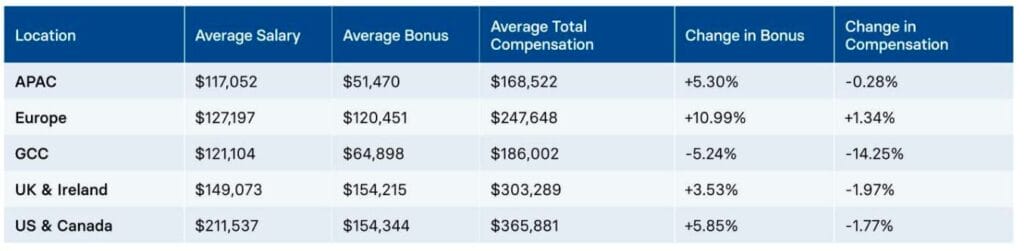
Compensation by Region, 2025
The gap is particularly pronounced at junior levels, where US-based analysts earn more than twice as much as their UK counterparts.
At the senior end, however, compensation structures flip. UK Managing Directors earn significantly more than their US peers, approximately $1.4 million compared to $736,000, reflecting a more bonus-heavy, top-weighted pay structure in the UK (see table in Notes to Editor).
Beyond discrepancies in pay, the US and UK & Ireland also show stark differences in overall wellbeing. Despite working broadly similar hours, 47.78 per week in the UK and Ireland compared to 48.9 in the US and Canada, professionals in the UK and Ireland report significantly lower levels of both physical and mental health.
Average physical health scores stand at 6.8 versus 7.8 in North America, while mental health scores are also lower at 6.6 compared to 7.5. Combined with lower overall compensation, this suggests that professionals in the UK and Ireland are working near-identical hours for less reward, both financially and in terms of overall wellbeing.
Together, these findings point to a widening quality of life gap, raising further concerns around the region’s ability to attract and retain talent in an increasingly competitive global market.
Peter Healey, CEO of eFinancialCareers, comments: “The latest figures highlight a clear and persistent gender pay gap in financial services, particularly in the UK, where men are earning significantly more than their female colleagues both overall and on an hourly basis. We know a major hurdle is lack of representation of females in senior positions. Our data shows that the disparity becomes more acute at senior levels. At the same time, total compensation across the sector has fallen slightly despite strong industry profits.
“This combination of declining salaries, uneven bonus growth, and widening disparities makes it more important than ever for firms to focus on fairness, transparency, and long-term retention strategies. Ensuring that compensation reflects both performance and equality is not only essential for attracting and retaining talent, but also for building a sustainable and inclusive financial services industry.”


![[UNS] celebrate](https://ifamagazine.com/wp-content/uploads/2024/11/jason-leung-Xaanw0s0pMk-unsplash.webp)